
Hiding in plain sight
The first real piece of the new mains cabinet, cut in quarter-inch MDF so that mistakes cost almost nothing. A slow day in a warm garage, most of it spent finding tools and learning to use a router, and it ends with a hole that the panel gear passes through.
No entry yesterday. Saturday was our wedding anniversary, and I spent it with the first mate rather than with the boat, which is the right way round.
Today was supposed to be the day the mains cabinet started to become a real thing. It got started. It did not get very far.
What changed since the practice cut
The last entry ended with half-inch King Starboard as the likely material and a hinge along the bottom of the panel. Neither survived the fortnight.
The panel is going to be painted marine plywood instead. Plywood is far stiffer than polyethylene for the same thickness, it holds a screw properly, and it does not take a set the way that quarter-inch sheet did. And almost every awkward step in the hinge design traced back to one thing: not being able to trust threads cut into Starboard. Take that away and a whole chain of workarounds goes with it.
The mains panel is also no longer going to hinge. It lifts out. Four captive screws, two handles, and it comes away whole with everything still bolted to it. There is no mains fault whose answer is to get behind the panel in a hurry. At the dock the answer is to switch the shore breaker off or unplug. So there is nothing to gain from a hinge, and a lot of fiddly geometry to lose. The twelve-volt panel underneath still hinges, because the bilge pump is fed from behind it and that one may need opening at sea.
Which is why the rehearsal is now in quarter-inch MDF rather than Starboard. The reason for rehearsing in the real material was to learn to cut it. Plywood cuts like wood, so what is left to prove is size and fit, and MDF proves those as well as anything and costs very little.
The garage
The workshop is the garage. We have done a fair amount to insulate it, and it still gets warm. The forecast keeps promising that the weather is about to break and the weather keeps not doing it.
Most of the morning went on finding tools I knew I had. Thank heavens for the first mate, who has eagle eyes and can see things sitting in plain sight in front of the captain when the captain cannot.
The other thing the garage does not have is space. There is a fold-out worktable, and that is the workbench. Every job starts by finding somewhere to put everything else. We make do with what we have.
A router, for the first time
The router is new. I bought it for this job, because it looked like the most useful tool I could have for it — not just for putting a roundover on an edge, but for cutting holes to a pattern. A fair amount of YouTube taught me the basics, and a bit of digging for something decent but not expensive convinced me this was the right one.
There is a big difference between watching somebody do a thing expertly on YouTube and working out how to do it yourself. That is where a lot of the day went: putting it together, then working out how it goes.
I tried it two ways: with a pattern bit, which has a bearing that follows a template, and as a plunge router. So far the pattern bit is the easier of the two for me by some distance. That matters, because the plan from here depends on it.
The backing
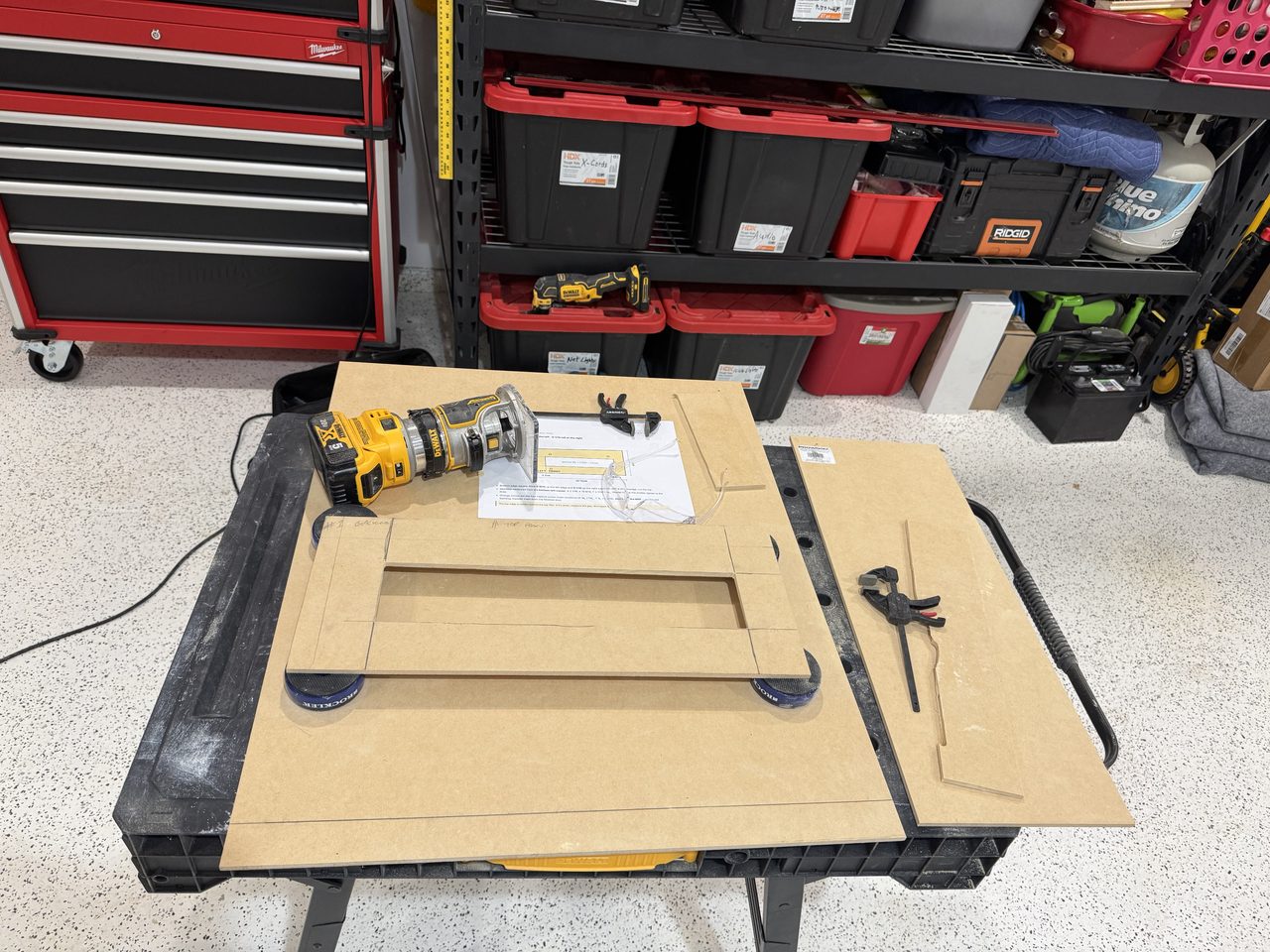
What came out of the day is the piece in the photograph: the backing panel for the mains cabinet. It stands behind the removable face and holds the whole box together. It is not the final one, it is the MDF rehearsal, but I think it is good enough to be the pattern for the plywood one. With the pattern bit following it, the real piece should be a far easier cut than this one was.
The top edge slopes, because the deckhead above it does. It falls about half an inch across the width of the cabinet.
The hard part was the hole in the middle, which is where the two mains units pass through. What worked in the end was the multi-tool. I marked a straight line, clamped a straight offcut of MDF along it, and ran the multi-tool against that edge. That is really doing by hand what the pattern bit does, with the offcut as the template.
Then the test that mattered: both Blue Sea units pass through the hole. They do.
Next
Time beat me again, so the next step is another day. The backing becomes the basic pattern for the front panel. I mark on it the parts that must not be cut away, which are the small squares left in each corner for the mounting screws and the divider between the two units. Then I cut the MDF front from that.
That will be the first real test fit of the panel gear in the face it will actually live in. With those two pieces done, the complicated cutting is pretty much over.
The backing is also all I need to take to the boat to check whether the measurements hold. I doubt I will get out there this week, but if I do, I must measure the notch at the back where the rail runs through, which I did not measure last time. It is the last dimension I am missing.