
Practice cut
One piece of plastic cut square, using a technique I had to work out first, and which is going no further than the kitchen table. A week when the heat and something I cannot shake kept me at home — which turned out to be the cheapest possible place to find out that the panel is the wrong thickness, and that the two sheets I already own are each about half right.
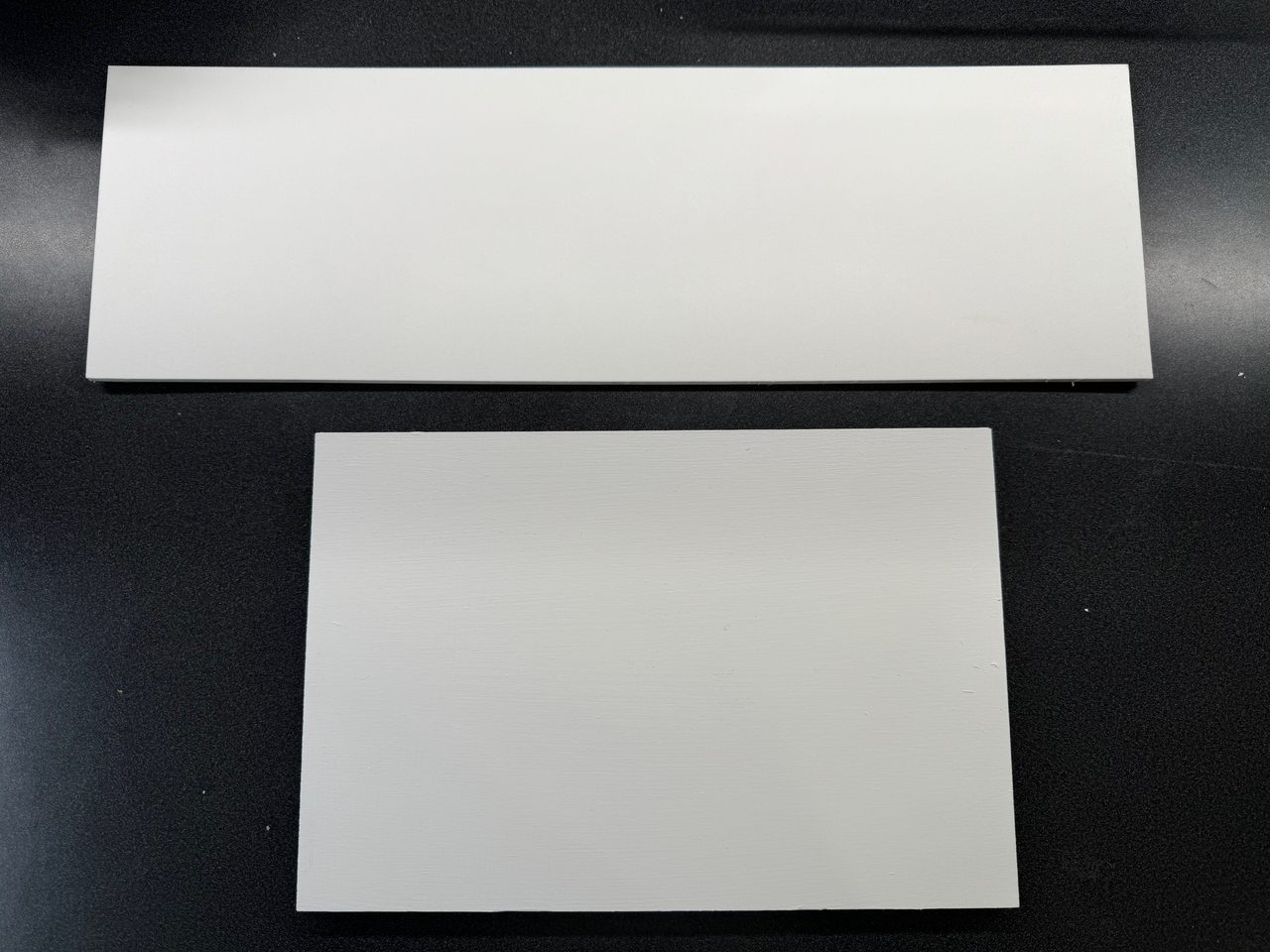
Last Sunday's entry finished by saying that Monday was a bench day, and that the upper panel would get laid out, marked and cut on the kitchen table.
It took the week rather than the Monday, and it did not amount to a full day's work even so. What came out of it is the long piece in the photograph, which is cut square, cut cleanly, and going no further than the kitchen table.
That is less of a waste than it sounds. It did take me most of the week to see it.
Why there is not more
I am still not up to strength. There is something that has been hanging about for a fortnight that I cannot name and cannot shake off, and the heat is not helping. It has been a hundred degrees or near enough for so long now that I have stopped counting individual days. It simply does not want to stop.
So this was a week at home, and mostly a week of planning. I had hoped to get further.
Cutting plastic is not like cutting wood
The panel is high-density polyethylene. The trade name is Starboard and the honest description is a chopping board: it does not rot, it does not take up water, sunlight does not touch it, and nothing sticks to it. That last property is why boatyards love it and also why you can never glue anything to it.
It also softens at around two hundred and fifty degrees Fahrenheit, and it is a poor conductor of heat.
Those two facts together are the whole problem. Every cut generates heat by friction. In wood that heat goes into the sawdust and the air and nobody ever thinks about it. In polyethylene it stays exactly where it was made, softens the material on both sides of the blade, and the cut closes up behind the blade and welds itself shut. What you get is a bead of re-melted plastic down the edge, a blade that grabs, and a line that wanders.
The instinct is to reach for a fine blade, because fine blades cut clean edges. It is exactly the wrong move. A fine blade has small gullets — the hollows between the teeth that carry the waste out of the cut. Fill those and the blade stops cutting and starts rubbing, and rubbing is nothing but heat.
So the answer is a rough-cut wood blade at six teeth to the inch, which is about as coarse as a jigsaw blade comes. Big teeth, big gullets, and every tooth takes a proper bite and carries it out of the kerf.
Then the speed down. The heat is made per tooth-pass, so a slower blade simply makes fewer of them.
Then the orbital action, which is the setting that swings the blade slightly forward into the work on the cutting stroke and lets it fall back on the return, so the teeth bite rather than scrape. Full orbit gives a fast, rough cut that wanders. Switched off, the blade cuts beautifully and rubs the whole time. One notch out of four turned out to be the balance.
And an offset fence riding the factory edge of the sheet, because a jigsaw blade will follow a pencil line approximately and follow a fence exactly.
It cut square and it cut clean. No melting, no smearing, no mess to clear up afterwards. Six inches by nineteen, which is the face that will carry every piece of mains equipment on the boat.
And then it is not going on the boat
Because it is a quarter of an inch thick, and the panel wants to be a half.
I did not work that out from a table. The finished piece has a curve in it, and you can see it in the photograph at the top of this entry — look along the lower edge, where it lifts away from the bench towards one end.
What makes that worth noticing is that it is lying on something flat and has not gone flat. If its own weight were putting the curve there, then its own weight would take the curve out again. It does not. So the bend is simply in the material: wherever that sheet has been sitting it has taken a set from something, and at a quarter of an inch there is not enough of it to resist.
And that is the sheet while it is still in one piece. The two apertures for the mains gear have yet to come out of the middle of it, and they will take away most of what is holding it straight. If it bends now, it will bend a great deal more then.
The other sheet I have is half an inch thick, and that one is dead straight.
The other half of it is the edge. I want a bevel on it, which is the detail that makes a cut sheet look like a made thing rather than an offcut, and a bevel eats most of a quarter of an inch.
So it would have looked thin. And then it would have looked thin and bent.
Half an inch in the wrong place
The panel covers a hole in the fibreglass and sits on the surface around it, which means its front face stands proud of that surface by its own thickness. Half an inch.
It hinges along the bottom edge and folds down towards me, so that when it is open I am looking at the back of it the right way up rather than groping at it through a hole. It latches along the top. And a hinge, being a flat thing, wants to join two surfaces that are in the same plane — which these two are not, by exactly half an inch.
There is a part made for that. An offset hinge has a step pressed into one leaf, so it can bridge precisely this kind of change in level. I could not find one in any size that would work here.
Which leaves putting the hinge on the back. That is neater in the obvious way — nothing shows from the front — but it changes what is holding the panel up. With the hinge behind it, the entire weight of the open panel hangs off whatever fixes that hinge to the back of the plastic. Screws would be invisible, which is the whole appeal of them. But I did not want the weight of an open panel hanging on threads cut into plastic. Starboard is soft and it relaxes under a steady load, which is exactly the kind of load a hinge applies, and a screw in it holds perfectly well right up until it does not.
So it would have to be through-bolted, and a piano hinge's worth of bolts would come through to the front anyway. The hidden hinge does not stay hidden.
Hence the packing. A strip nineteen inches wide — the same width as the panel — and the same thickness as the panel, laid on the fibreglass above and below the opening. It brings the fixed side up into the same plane as the panel face, and an ordinary flat hinge will then span the two without any cleverness at all. The latches at the top get the same treatment for the same reason. It does not much matter what the strip is made of, since nothing about it is structural: Starboard, or a length of plywood painted white, whichever is to hand.
And the part that turns it from a workaround into the right answer is what happens to those bolts.
The bolts were always going to show. This way they show through something that reads as a hinge, and the thing they pass through is carrying the panel rather than merely being pierced by it.
Two kinds of white
I have two sheets of white plastic to choose between, and they are not the same material. Only one of them is in the photograph, which is worth saying, because the white board below it is a piece of painted plywood and has nothing to do with this.
The one I cut is genuine King Starboard, in quarter inch. The other is the cheaper high-density polyethylene I bought from Amazon, in half inch. Put side by side they do not look even vaguely alike — not a shade apart, visibly different things.
And between them they have managed to be about half right each.
The King Starboard looks the part and will not stay straight. The Amazon sheet is perfectly stiff — it lies dead flat, it is the thickness I want, it would do everything the panel has to do structurally — and it looks cheap. That matters more here than it would somewhere else. This panel ends up directly in front of anyone sitting at the chart table, and it is going to be the most looked-at piece of work in the cabin.
Nor would using it save me the shopping. The piece I have is six inches by twenty-four, which cuts down to the mains panel with room over — and does not touch the twelve-volt panel underneath, which is nineteen by nine. I would be buying more of it either way.
Which points at half-inch King Starboard, and half-inch King Starboard is not cheap. The quarter inch was not cheap either, but this is a different order of expense, and I need enough for two panels rather than one.
None of that is a disaster, and every part of it would have been a genuine irritation to discover with one panel already cut and hanging on the bulkhead. Finding it at the kitchen table, with two uncut sheets in front of me, cost nothing at all.
The rehearsal
Which is what finally gives the quarter-inch its job. I have plenty of it, it is too thin to use, and those two facts together make it precisely the right thing to make mistakes in.
So both faces get cut, marked, drilled and dry-fitted in it first — real components bolted on, the whole assembly offered up to the real hole — before I cut anything I have paid properly for.
The obvious cheaper version of that is to template in plywood from Home Depot, and I am not going to, for a reason that is really the whole point of the week. Plywood does not behave like Starboard under a blade. It does not soften, it does not weld itself shut behind the cut, and it does not care what speed I run or how many teeth are on the blade. A faultless plywood template would tell me the apertures are in the right places and the panel fits the hole.
And that is the only reason to rehearse at all.
The other piece in the photograph
The smaller board is half-inch plywood, painted white, and it is the backing plate for the second battery charger — the one that maintains the engine-starting battery, which has been sitting aboard unmounted since August for want of somewhere to put it. It gets bonded into the port lazarette alongside its sister, the one that charges the house battery.
Its size was not calculated. There was an offcut already cut to something, I held it up in the space to see what it looked like, and it turned out to be exactly right. I have still not measured it.
It is painted already, though, which is the point of mentioning it. The last time I did one of these I bonded the board in first and painted it afterwards — which means bending over the coaming, reaching down into the locker, and then working the brush at whatever angle will get it in under the lip. Not impossible. Just slow, and much harder on the cut edges, which are the part of a board that most needs the paint. The time before that I had to unbolt the galvanic isolator and redo its battens for the same reason.
What else got done
The calculations for the two apertures in the mains panel are done and the cutting masks are made — the shapes that get taped to the face so that I am cutting round something rather than freehand. The cutting itself has not happened.
And I have been back over the wiring plan, tidying it into something I can actually build from rather than something I can argue about. That is the job that has to be finished before any of this becomes work on the boat rather than work about the boat.
Then a long stretch on Amazon, which is the least satisfying thing on this list and the only one with a clock running on it. Splitting one panel into two changed what a good number of the parts need to be, and everything I had in the house was bought against the old plan. So: work out which pieces are now wrong, send them back while the return windows are still open, and order what replaces them.
It does not feel like an achievement. It is also the difference between the next decent weekend being spent building something and being spent discovering I have the wrong part in the box. I will take it.
Where it leaves it
The forecast is hot for the rest of the week and then possibly, cautiously, cooler by the weekend. Fingers crossed.
Laying out a panel is a job that breaks into small pieces, and it is a job I can do at the kitchen table in an evening without needing to feel well. So I may get at it in halves during the week, which would be the best possible outcome: it means the next decent weekend gets spent on the boat rather than on the preparation for the boat.
Not much of a week. But the panel is one thickness better specified than it was, the material question surfaced while it was still free to answer, and I now know how to cut the stuff.