
Clean
Two small jobs on Friday morning, done the sensible get-it-working way, and the feeling afterwards that I had spent it rearranging a mess rather than clearing one. What followed was an audit of everything I have already built, a decision to undo a good deal of it, and a Sunday spent on the floor.
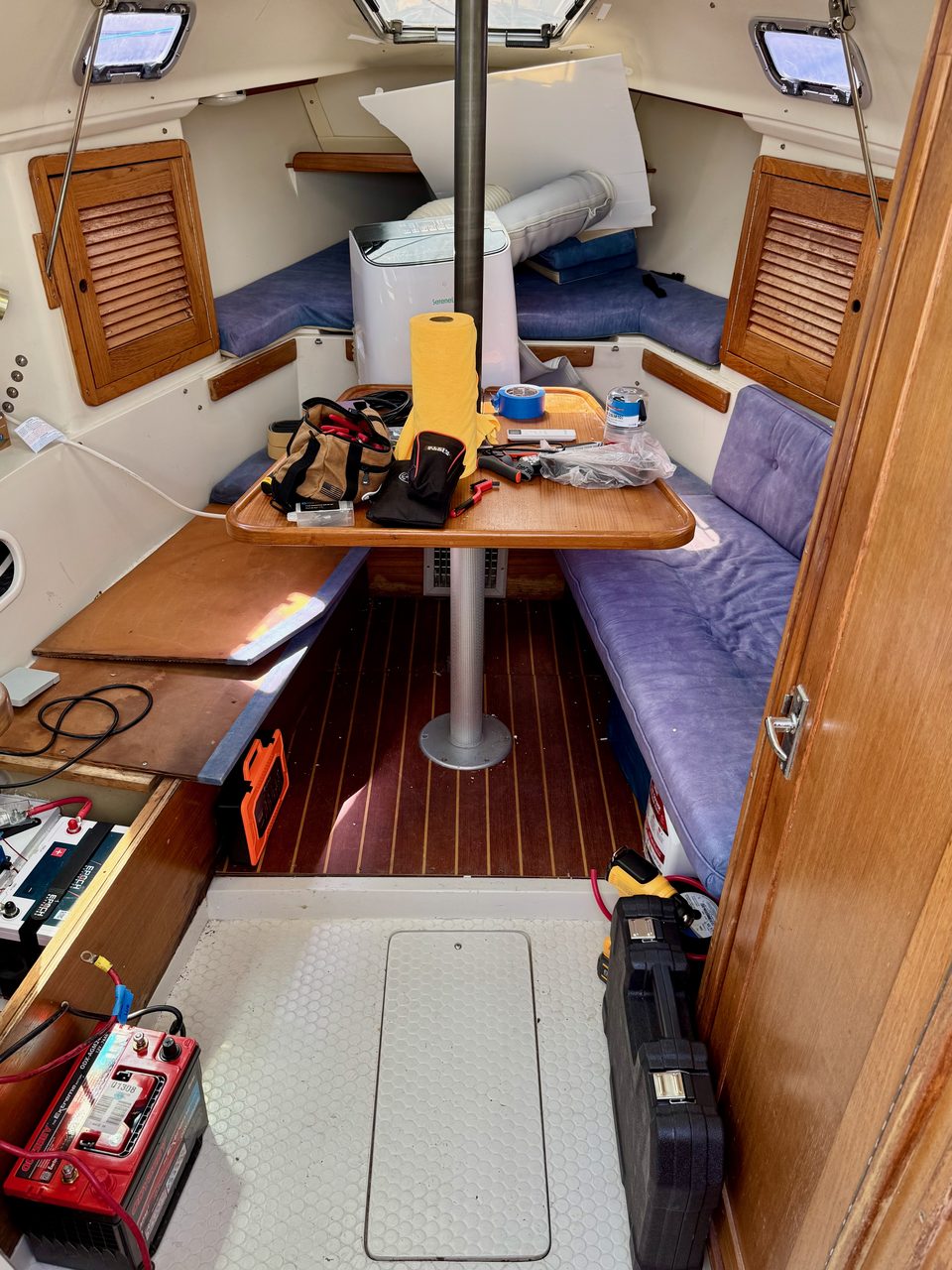
I was not well on Friday, which is where this starts.
I went to the boat anyway, because there is a great deal to do and the season is not getting longer, and stood in the cabin working out what I was actually capable of. Not a big job. Not anything that had to be finished before I could leave. Something small, self-contained, and visible enough afterwards that the morning would feel like it had counted.
The answer was the DC panel. Get the twelve-volt side of the new panel connected and get the bilge pump running off it.
A job chosen for its size
That choice was shaped by how I felt rather than by what the boat needed, and it is worth being honest about which parts I skipped.
The proper version of that job starts by replacing the common bar behind the panel — the bar where all the return wires land — because the existing one is too small to take a cable the size the new panel needs. Change the bar and you are into re-landing every branch on it, which is a job in itself and not the morning I had.
But the old cable was still there and still reached. Land that on the battery compartment, plug in the pump, and both things work. Two small jobs, neither of them permanent, both of them progress.
The first one is where I met the copper.
Bare copper
The terminals behind that panel are in poor condition. Heavily oxidised, all of them.
The reason is not neglect, and it is not bad luck. They are bare copper rather than tinned copper, which means somebody, at some point, saved a little money.
There are three kinds of cable a person might reach for, and two of them look near enough identical once they are installed.
House wire is the odd one out and nobody is confused by it — a solid core, or a few thick strands, meant to go through a wall once and never move again. Nothing on a boat wants that.
The one that catches people is automotive. It is stranded, which looks right, and it is cheap and in every parts shop in the country. But the strands are thick and the copper is bare. Marine cable is stranded far more finely — hundreds of strands where the automotive equivalent has dozens — and every one of them is tinned from end to end.
Both of those differences are doing a job.
The fine stranding is about movement. A boat vibrates when the engine runs and works when she sails, and a conductor made of a few thick strands will eventually fatigue and break where it flexes. Hundreds of fine ones share that movement out between them.
The tinning is about water, and it is the one that matters here. Boats are damp — not occasionally, but as a condition. Moisture gets into a cable at its terminal, and then it does the thing that makes this so much worse than it looks: it wicks along the conductor underneath the insulation, corroding as it goes.
Tinning does not keep the water out. It stops the water mattering.
And corrosion does not sit still. A corroded joint has more resistance, resistance makes heat, and heat accelerates corrosion. It feeds itself, quietly, for years.
This is not a theory about the terminals, either. There is non-marine wiring elsewhere aboard — household-pattern cable joined with twist-on wire nuts, down at the bilge pump of all places. It is a pattern rather than one bad afternoon.
So: marine cable costs two or three times what automotive costs, and across a whole boat that is a real number — enough that on the day you are standing in the shop, the cheaper stuff looks like the sensible adult decision. It goes in looking identical. It works perfectly. And then the boat does what boats do, and the difference you could not see on the day turns out to be the only difference that was ever going to matter.
There is an arithmetic that settles the argument about where the money goes. Sixteen feet of the heavy cable that starts the engine has a resistance of about two and a half thousandths of an ohm. One corroded ring terminal is somewhere between five and fifty thousandths.
So I sanded each one back to bright metal, knowing every one of them is coming out later anyway, and landed the cable.
The bilge pump, and one small compromise
The other job was the pump, and it went in wrong in a way I want to write down, because twenty minutes later it is why the rest of this entry exists.
The spade connectors on the new panel are a size larger than anything I have seen on twelve-gauge wire. I had bought oversized ones to suit, which was the right call and they fit beautifully.
The trouble is the piggyback connectors — the ones with a second tab on the back, so a signal wire can share the terminal. The bilge monitoring needs one, so that the boat can tell me from home when the pump has run. Piggybacks are made in the standard size. They are not made in this strangely large size, or at least not anywhere I could find on a Friday morning.
So: cut the old ends off, crimp on the big ones I had, clean everything up as well as it would clean, connect it, and get the pump running. Which it now does.
It works. It is also a joint that will be cut off and made again when the monitoring goes in.
The pump end of it was worth doing properly regardless, so I checked it three ways rather than one. It runs with the main battery switch off, which proves it is fed from the side of the switch that the switch cannot reach. It runs when I lift the float by hand, so the automatic path works and not just the manual one. And the panel lamp lights on both.
The meter read 13.4 volts and the lamp that had refused to light for a week lit. Swallow had been sitting without automatic bilge protection since the panel came out, and she is not now.
The feeling in the stomach
Two jobs done. Both of them working. Progress, by any reasonable measure.
And I sat there afterwards with a feeling I recognise from other parts of my life, which is the feeling of having spent a morning moving things around inside a mess rather than clearing one up.
Nothing I had done that day was wrong. The cable is the right cable in the wrong condition. The connectors work and will be cut off. The bar behind the panel is too small and is still there. Every single decision was defensible on its own and the whole thing was getting worse.
So I packed up and left, which was not much past midday, and spent the afternoon at the kitchen table thinking about it instead. That turned out to be the more productive half by a distance.
The panel I have already replaced
In August I replaced Swallow's original electrical panel. The one I chose was chosen almost entirely because it changed as little as possible — a modern version of exactly the same thing, into exactly the same hole, on very nearly the same screws. That was the whole appeal. One weekend, one swap, done.
It went in. It worked.
Then the problems started, and what follows is a list, because not one item on it is a disaster.
The shore-power safety device has to go somewhere. It is the thing that cuts the boat off if current starts leaking away where it should not, it is worth having, and the new panel occupies every square inch the old one did. So it needs a panel of its own. Fine — a small one.
Except that it arrives with its own mains switch, its own reversed-polarity warning and its own power-on lamp, all of which the panel I had just fitted already has. That is not merely duplication, it is a question I would have to answer for anyone I hand the boat to. There are two master switches now. Which do you use? Do you turn off one, the other, both, or does it not matter?
Then the monitoring. The new panel has a battery voltage gauge, which sounds like it covers the ground and does not — voltage is a rough guide to how a battery is doing and tells you nothing about how much you have used or how much is left. The system that does tell you is already installed and already talking to my phone from home, and it needs a screen. There is nowhere to put a screen.
So the small panel grows slightly and takes the screen as well. Fine.
Except that the standards are firm, and right, that mains and low voltage should not share a space. The point is not neatness. It is that somebody working behind what they believe is a twelve-volt panel should not be able to put a hand on a hundred and twenty. The panel I fitted handles that by putting an acrylic box around its mains section, which is awkward to work in. And the safety device is mains, and the monitor screen is twelve volt — so putting both on my new small panel recreates precisely the problem I would be trying to avoid.
Then the busbars, which are the common bars where all the return wires land. The new panel has excellent ones for the positive side and none at all for the negatives, the earths or the mains neutrals. Those still live on bars screwed to the back wall of the old panel space, where the twelve-volt ones sit immediately beside the mains ones. Which is the same objection again.
And at least there is a master switch for the twelve-volt side.
There is a switch. It is a disconnect rather than a breaker, which is not the same thing — it will isolate the system but it will not trip. The busbars behind it are rated at a hundred amps and nothing in the installation guarantees they never see more. In practice they never will. In principle, nothing is stopping them.
And then the wire colours.
Twelve-volt positive has traditionally been red and negative black. There was never much reason for it beyond that being what everyone did. The trouble is that on a boat with mains aboard as well, American practice makes the live conductor black and the neutral white.
That is a bad question to get wrong, which is why the standard now asks for twelve-volt negative to be yellow.
The panel I fitted in August uses black.
Not one of those is a catastrophe, and every one can be worked around on its own. That is exactly what makes it insidious. At no point is there a moment where stopping is obviously the sensible thing to do.
I groaned inwardly as the truth became annoyingly clear.
Two panels instead of one
The right answer is the one I did not want, and it is to stop working around it.
There are two spaces available — the one the old panel came out of, and the new one I was going to build for the safety device. So use them properly. The upper space becomes mains, and everything mains lives in it and nothing else does. The lower space becomes twelve volt, and the same rule applies.
Almost everything on that list then stops being a problem rather than getting solved. The separation is the layout instead of a box inside a layout. There is one mains master switch, because the mains panel I build has one. The busbars get sorted because I am building the space they sit in. The screen has a home. And every wire I run from here is the right colour, because they are all new wires.
The cost is that it means undoing work I finished three weeks ago and designing two panels from nothing — measuring, drawing, laying out, and cutting them by hand.
And the same is true of the battery compartment
Once you start pulling that thread it does not stop at the panel.
The battery compartment holds the two batteries, the main fuses, the electronics that watch them, a shelf, a leaking fresh-water pump, and a certain amount of hope. It is a locker you open by lifting a seat cushion, so anybody aboard can open it, and things get dropped into it.
Putting the electronics in there seemed obvious at the time. You are monitoring the batteries, so you put the monitoring next to the batteries. The cable runs become inches instead of feet, everything it needs to measure is right in front of it, and it keeps the clutter out of the cabin. In August I bonded a backing board onto the compartment wall and mounted them on it.
On most boats that would be the right answer. On this one it is not, and the reason is the reason behind most things on a twenty-seven foot boat: somebody had to make a compromise somewhere, and it was not made in my favour.
The fresh water system runs straight through the battery compartment. The pump sits on the shelf between the two batteries, because the tank is immediately forward of it and that is where the plumbing wanted to go. And that pump has been leaking at its housing since before I owned her — it is written into the survey, in plain language, as a defect.
So the compartment I chose for the electronics has a known water leak in the middle of it. Not a splash off an open hatch. A fitting that drips, quietly, onto a shelf, and has been doing so for years.
The cleaner answer is to take all of it out and move it behind the DC panel instead — up in the cabin, dry, out of reach, and behind a panel nobody opens by accident.
One thing cannot come. The shunt measures every amp going into or out of the house battery, and to do that it has to be bolted directly to that battery's negative terminal. It is not a preference; it is where the measurement happens. So it stays, and it gets a cover instead.
What is left is a compartment holding two batteries, two fuses, one instrument and a water pump, laid out with everything positive at one end of the shelf and everything negative at the other, and the pump sitting between them like a bollard. The point of that is not neatness. It is that if somebody drops a spanner in there, there should be nothing for it to land across.
The fusing, which was the same mistake again
Every battery aboard has a fuse at its positive terminal. Its job is not to protect the equipment. It is to protect the cable — so that a heavy cable which chafes through somewhere and touches metal does not quietly become a heating element until something catches fire.
The two batteries appeared to want different things from that fuse.
The engine-starting battery has to survive cranking, which pulls a couple of hundred amps for a few seconds at a time. So: two hundred amps, in a fuse that bolts straight onto the battery terminal.
The lithium house battery is a different problem entirely. A large lithium battery shorted out can deliver a genuinely alarming amount of current — thousands of amps, near enough instantly — and an ordinary fuse in that situation does not part politely in the middle. It vaporises, and the arc carries on conducting across the gap it just made. There is a class of fuse built to break that arc; they are called Class T, and lithium gets one. It was going to be a hundred and fifty amps, which is about right for a bank expected to deliver a hundred.
Each of those was the correct answer to its own question. Together they were two fuse types, two ratings, two mountings, two sets of tools and two sets of spares — and, inevitably, never the right spare in the box on the day.
So both sides now get the better fuse, and both get two hundred amps.
That costs a little more than it strictly needs to on the engine side, because Class T fuses are not cheap. What it buys is one part number. Same fuse, same holder, same tool, one pool of spares, and it does not matter which one has blown. Nothing is given up for it either — two hundred amps still protects the cable, which is the entire purpose of the fuse, and the house side will never come close to it because everything downstream is already limited by a hundred-amp breaker.
The argument that actually convinces me is not about money or neatness, though.
The records are not clean either
There is a third thing that is not tidy on this boat, and it is not physical at all.
Swallow came with no service history whatsoever. There is a survey from June and there are my own receipts, and before that there is nothing at all. Thirty-three years of somebody looking after her, or not, and no record either way.
That is not an abstraction; it lands on me most weeks. Is that pump four years old or twenty-four? The rubber inside it is on a three-year replacement interval, which is a useless instruction when the clock has no start point. Multiply that by every hose, seal, impeller and length of wire aboard.
The trap is thinking the answer is to replace things on age, because age is precisely the thing I do not have. What I have is a component that might be original and might have been fitted eight years ago, and no way to tell the difference by looking.
So there are three honest responses, and none of them is a guess. If the part carries a date code, read it. If it is an annual service item, assume it is due and do it. And if it is something with a life, it becomes a judgement about consequences: what does it cost to run this one too long, and can I look inside it?
But the part that actually bothers me is not what the people before me failed to write down. It is that I am on course to do exactly the same thing.
I am three months in and I can already feel it going. Did I paint that backing board or only sand it? Was the isolator the weekend before the panel came out, or the one after? Some of it is in this log, which is more than most boats get — but a log is a story, not a record. It tells you what a day was like. It does not tell you what state a component is in.
Next year I will remember less. In five years I will remember almost none of it, and I will be standing in front of some fitting wondering whether I have already dealt with it.
So there is now a maintenance log on this site: every service, modification and renewal with a date against it, what is due and roughly when, and — just as usefully — an honest register of everything that has never been touched, saying what is actually known about each item rather than what is assumed.
From here on, anything replaced or serviced gets a date recorded. It costs nothing today. In five years it is the difference between knowing and guessing.
Drawing it out
The last piece was the wiring, which had grown complicated in the way plans do when they are revised one decision at a time.
I drew it out properly — the actual shape of the boat with the actual runs on it, rather than a schematic that shows what connects to what but not how far it has to go. Two things came out of that.
The first is that every heavy cable arrives at the battery compartment from the same direction, because both the engine and the chargers are aft of it. So the fuses and the monitor want to be at that end and the batteries at the other, which is a small thing that will save a surprising amount of cable.
The second is a change to the plan, and a good one. The main circuit breaker for the house side was going to live in the battery compartment, between the fuse and the battery switch. It now goes on the far side of the switch instead. The breaker protects the things drawing power rather than the cable feeding them, which is what a breaker is actually for; the switch can isolate it for service; and it leaves the terminal on the battery side of the switch free — the one the switch cannot reach — which is exactly where the bilge pump and the monitoring want to be, so they carry on regardless of what else is turned off.
And one method, which came out of not wanting to be on the boat at all.
The space behind the panel is reached through an opening seventeen inches by seven. Every argument about that space for the past month has been about what will fit through the hole, because the hole is where you have to put your arms and your head and a screwdriver while doing delicate work upside down.
So do not do the work in there. Build each assembly flat on the kitchen table — board, components, wiring, labels, all of it — and then put the finished thing through the hole and land four cables.
The catch is that a finished assembly still has to fit through seventeen by seven. Which turns out to be a useful constraint rather than an obstacle, because it pushes almost everything onto the hinged panel itself rather than onto the wall behind it.
The switch, the breaker panel and the display go on the front, where you use them. The main breaker goes on a small board behind the display, carried on the same threaded rods that hold the display in — so when the panel folds down it is facing me, the right way up, instead of being somewhere at the back of a hole. Three heavy cables come up from the battery compartment, one heavy cable leaves for the starter, and everything else is short wire between components that are already bolted to the same piece of board.
What is left for the wall behind it is the monitoring — the Victron box, the cellular modem, and the small fuse block that keeps the bilge and the monitoring alive when everything else is switched off. That gets a board of its own, because it is the one thing back there that will ever want taking out again.
None of that is built. Not one screw of it. What I have instead is a plan, and the plan is clean.
Saturday
Nothing. I still felt rough, and there was a friend's daughter's wedding, which is a better use of a Saturday than a boat locker in any case.
I spent a good deal of it turning the above over in my head, in the way you do when you have decided something and are quietly checking whether you still agree with yourself. I did.
Sunday, and the floor
Which brought me back on Sunday, still not up to a hard day, looking for something useful that did not require one.
Swallow has been getting harder to work on, and not for any reason to do with the boat.
The problem is an hour and a half in the car. It is only seventeen miles each way — it is traffic and lights that make it ninety minutes, not distance — but the effect is the same. If I am aboard and discover I need something that is at home, that is not an inconvenience, it is the end of the day. So everything comes with me, and everything stays. Tools, spare parts, offcuts, packaging, the thing I bought in July for a job I have not started.
The result is that I would put a screwdriver down, turn round to do something else, and three minutes later be unable to find it, because it had joined a pile. I have lost more time this summer to looking for things I was holding a moment ago than to any actual job on the list.
So Sunday went on taking things off her. Everything I could not imagine needing in the next fortnight went into one of two places: the lock box at the dock for things that can stand the heat, and the car for everything else. Then the tools that stayed got sorted into groups that mean something, and the sole and the table got cleared.
It does not look like a showroom. It looks like a boat with a floor.
What a clear floor is actually for
There is a thing I have been unable to find for weeks. The shore-power safety device — the one this whole redesign is partly about — arrived in August and has been nowhere since.
I had convinced myself it must be at the boat, because it was not at home. The trouble was that "not at home" was a feeling rather than a fact, and the same was true of the boat.
It is at home. It was in a storage closet the whole time.
While I was in there
Clearing lockers puts you in places you would not otherwise go, with a torch, unhurried. Three things came out of that, none of which I went looking for.
I finally laid hands on the bilge pump. This is slightly embarrassing — it has been on the list since June under the heading go and actually look at this, and every visit something more urgent happened instead. Meanwhile four separate decisions had piled up behind it, all waiting on one number, which is written on the side of it in letters half an inch high.
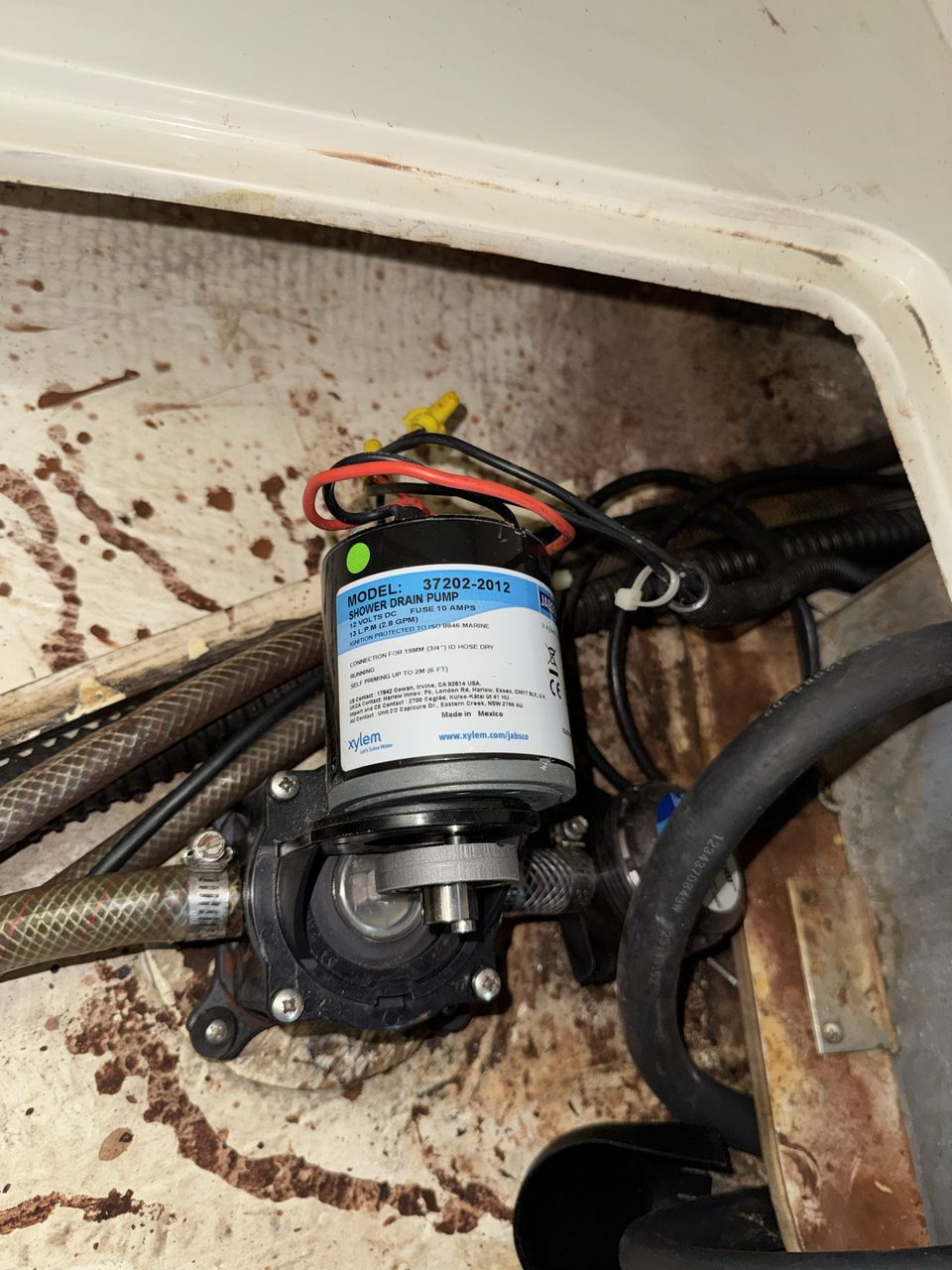
Ten amps. It is in good condition. It also moves when you push it, which it should not, so its mounting needs redoing, and one of the hoses carrying water out of the boat has perished past any argument. Two new jobs, neither welcome.
The bilge itself was dry, which settles something. Since June there has been an open question about whether the water that keeps appearing gets in through the deck or up through the gland where the propeller shaft leaves the hull — two entirely different repairs, and hard to tell apart on a lake where everything tastes the same. It has not rained in six weeks, and for one of those weeks there was no bilge pump connected at all. The bilge and the tray under the engine are both bone dry. Water below the waterline does not care whether it has rained, so that is the argument over: it is coming in from above.
And then a small blue box on the back of the engine that nobody has been able to identify, because it sits inside a painted shroud with the writing facing the wrong way. I photographed it and read the numbers off at home.
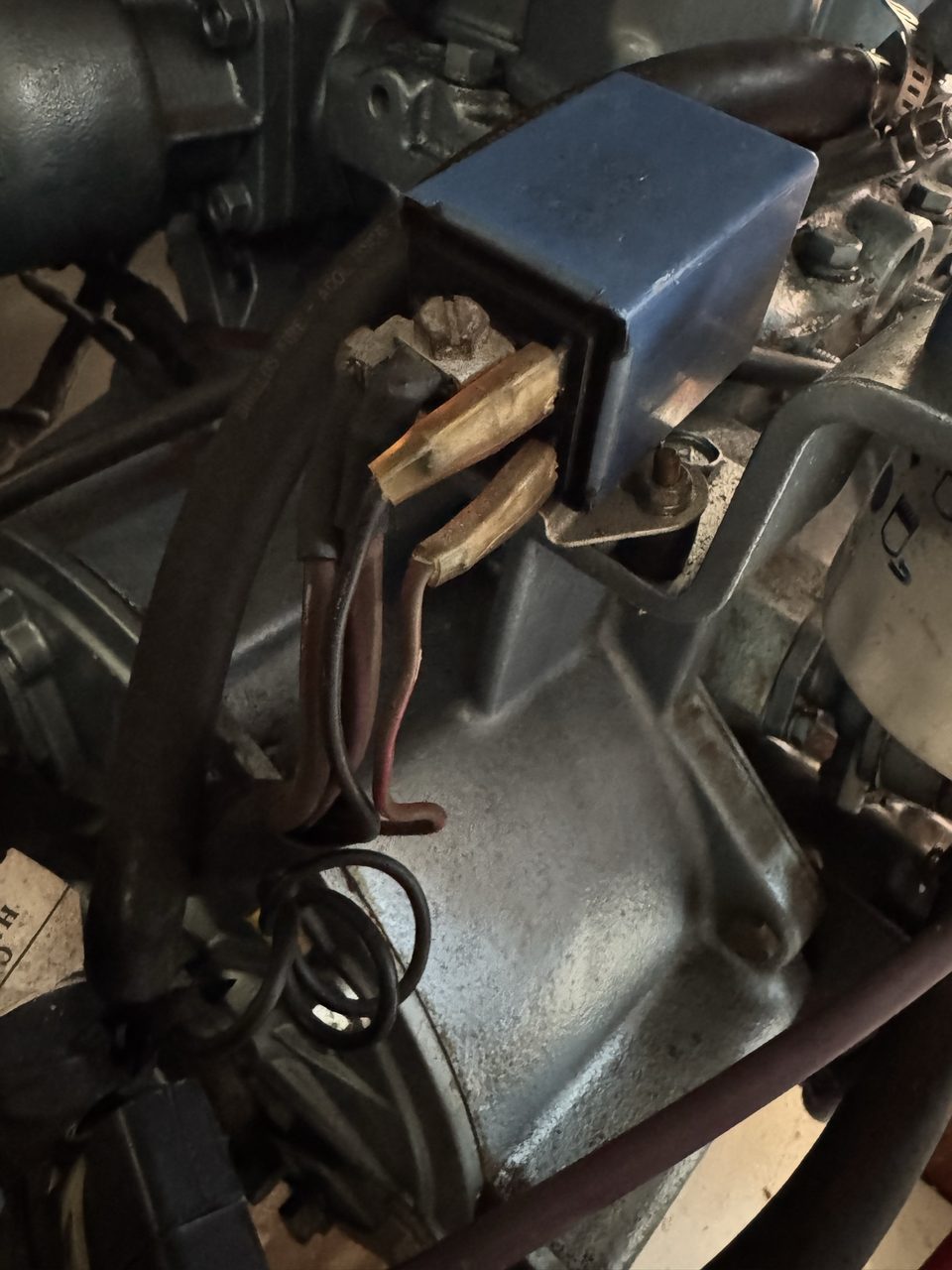
It is a Lucas relay, and the part number belongs to the twenty-four volt version. Swallow is a twelve volt boat.
A coil built for twenty-four volts needs somewhere around sixteen or seventeen to pull in reliably. On twelve it may work, may work sometimes, or may never have worked at all — and the fault I have been chasing on this engine since June is an intermittent failure to crank. No click, nothing, and then perfectly fine the next time.
I am not claiming to have solved it. It may not be in the starting circuit at all; that family of relay gets used for glow plugs too. Or it may have sat there doing nothing for thirty-three years, which would be its own kind of finding. There is a test that separates all three and it takes a multimeter and about a minute.
It will have to wait, and the reason matters more than the finding does. I am not working on the engine. I am working on the electrical system, and it goes in order: mains panel, then DC panel, then the batteries and everything that watches them. The engine comes after all of it.
Where that leaves it
Tomorrow is a bench day, and for the first time in a while it needs nothing from the boat. The upper panel — the one that will carry all the mains equipment and nothing else — gets laid out, marked and cut on the kitchen table. Nineteen inches by six. Everything it needs is at home, including the part I spent a month failing to find.
Beyond that there is a good deal of undoing to get through before there is anything to show. The electronics come back out of the battery compartment. The connectors I crimped on Friday get cut off. Two panels get built from flat sheet, and a fair amount of what I was pleased with in August comes apart.
None of that has happened yet. The boat is in exactly the state it was in on Friday morning, electrically speaking — same panel, same board, same too-small bar behind it.
But the plan is clean now. And so, for the first time since June, is the boat.