
The connection I never made
The port lazarette has power in it and the house charger is mounted and charging. Then an hour with a multimeter, chasing a light that would not light, over a connection to a brand-new busbar that I had never actually made.
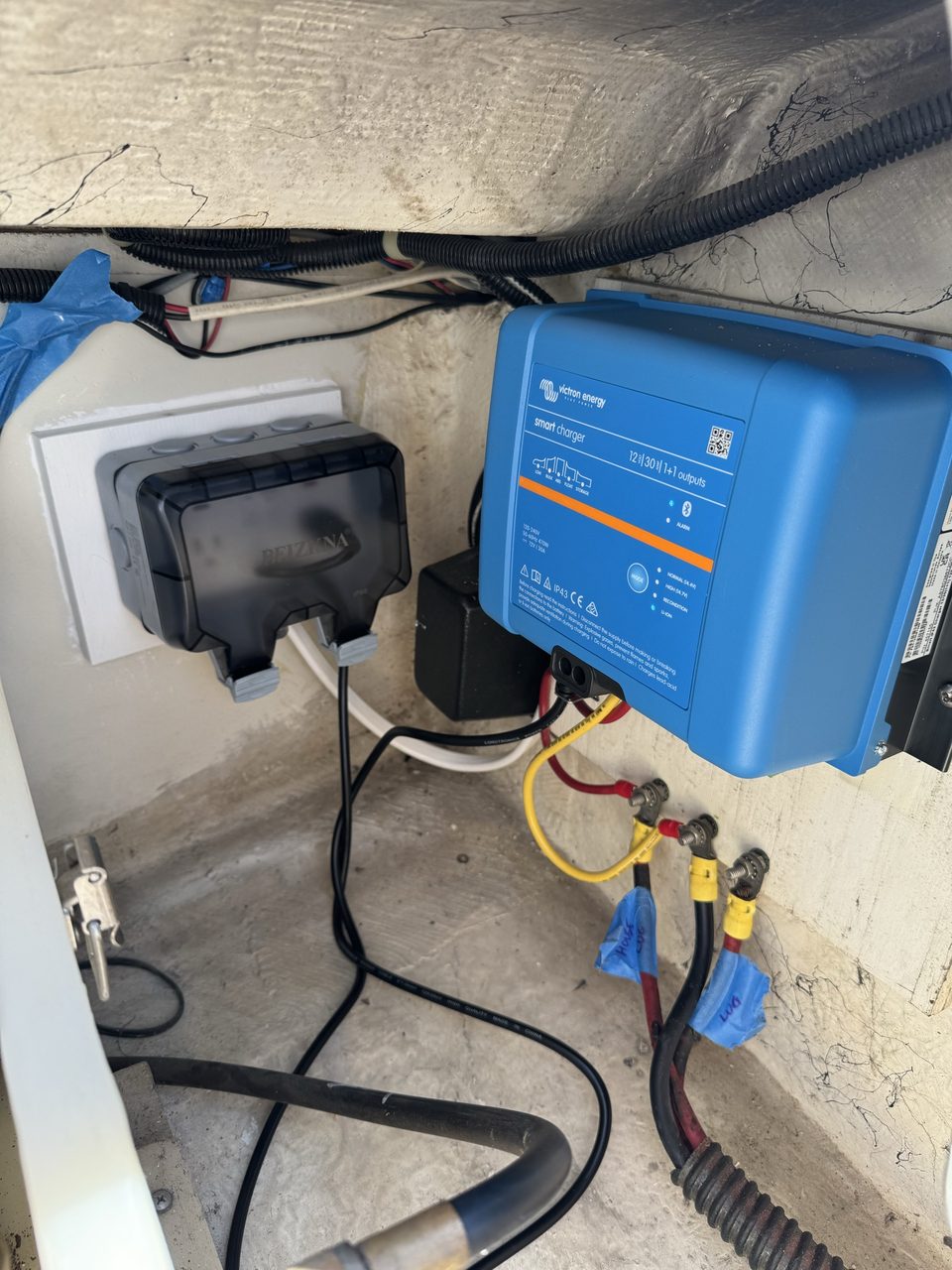
Most of today was spent outside the boat rather than inside it, which in a Texas August is the wrong way round. The port lazarette is a locker you work at from above, kneeling on the deck with your head and shoulders down inside it. There is no shade in that position, and it got hotter all afternoon.
The job was the chargers. One of the two went in.
Power in the locker
Nothing could happen until there was somewhere to plug them in, so the first thing to go on the wall was a weatherproof two-gang outlet box, sealed and switched, screwed to the backing board I bonded in two weeks ago. It runs off the charger circuit on the new panel, and it works.
That is a small thing that unlocks a larger one, and the reasoning for it changed underneath me.
The original plan had a single charger doing double duty, looking after both batteries. Its mains supply was going to be simple: cut the molded plug off the lead and take the bare end back to the panel. That is less brutal than it sounds, because the lead on that charger unplugs from the unit. Ruining one is reversible. Buy another lead and it is back to standard.
Then the plan grew a second charger. The one I bought to look after the engine-starting battery is a cheaper unit, and its lead is permanently attached, with a sealed plug molded on the end. Cutting that off is a decision you do not walk back. That left me running two mains leads the length of the boat, one of them a one-way choice, to arrive somewhere worse than where I started.
Mains power already runs out to that locker. A sealed outlet on the end of it takes both plugs exactly as they come, switches each of them independently at arm's length, and leaves an outlet in a place I will certainly want one.
Then the charger itself. It is mounted vertically with its terminals pointing down, which is not a matter of taste — it is cooled by air moving over it rather than by a fan, so which way up it sits changes how hard it can work.
It is charging. The house battery is taking power from it as I write this.
One caveat I want on the record: the heavy cables carrying its output out of the locker are the ones the old charger used. They are sound enough to prove the thing works and they are not staying. They get replaced along with everything else in there.
No room for the second one
The other charger is aboard, set up, and not mounted, because there is nowhere to put it.
There are two chargers rather than one because a single charger with two outputs runs one recipe for both of them, and the two batteries want noticeably different treatment. The lithium house battery and the lead-acid battery that starts the engine disagree by about half a volt on what a full charge means, which sounds like nothing and is the difference between a battery that lasts a decade and one that quietly dies in three years. That may well be what happened to the pair that were in her when I bought her.
I configured it before it goes anywhere near a terminal. That one has no buttons on it at all — its setting is invisible unless you connect to it with a phone — so getting it right while it is sitting on the saloon table is easier than getting it right later.
There is a good space for it beside and slightly below the first, and I have a piece of wood that fits. It comes home with me this week, gets painted at the kitchen table, and goes back epoxied into place.
The first time, I bonded a pair of battens into a locker and then had to unbolt what was mounted on them to get a brush into the corners.
Two things that stay on
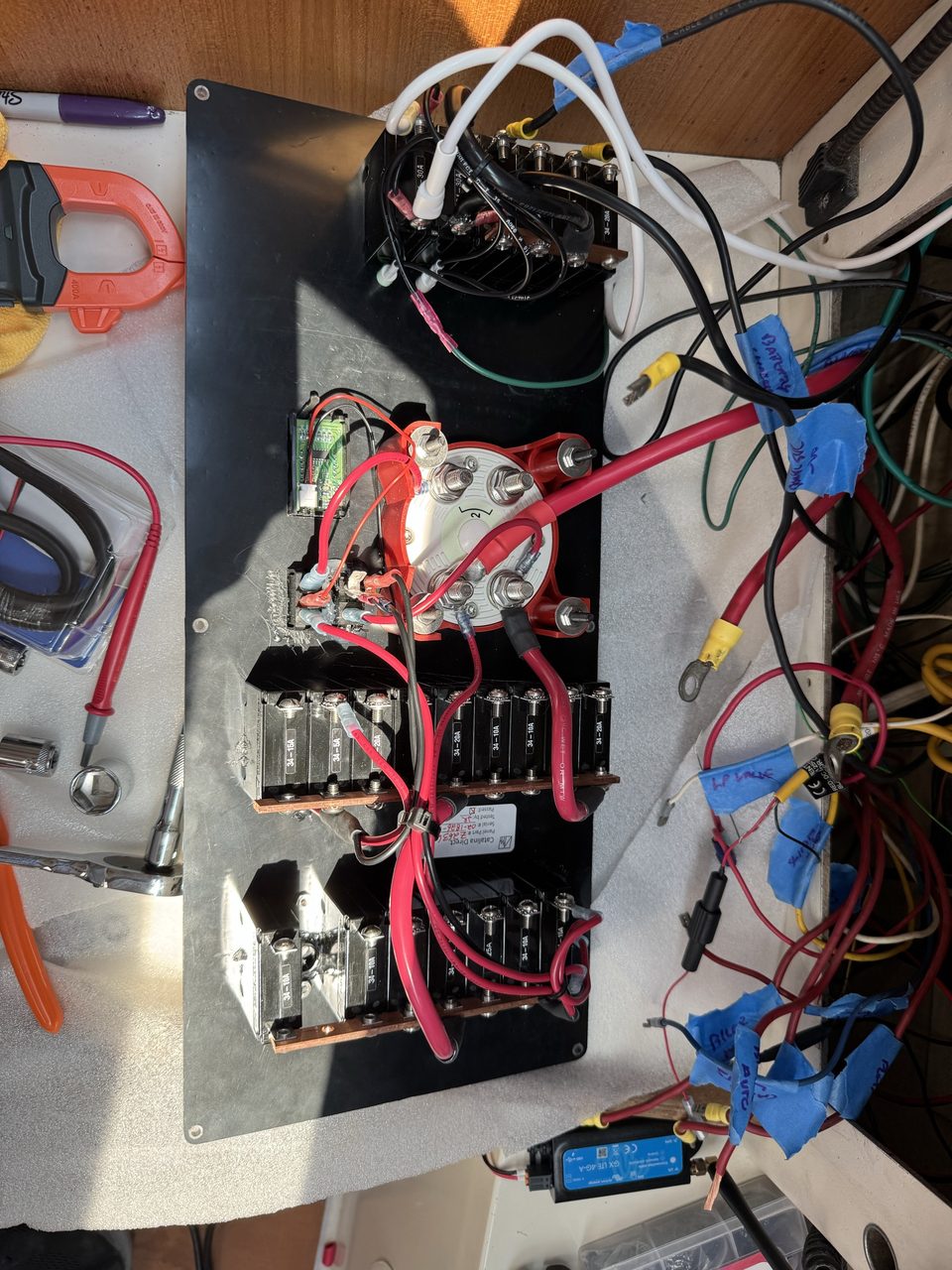
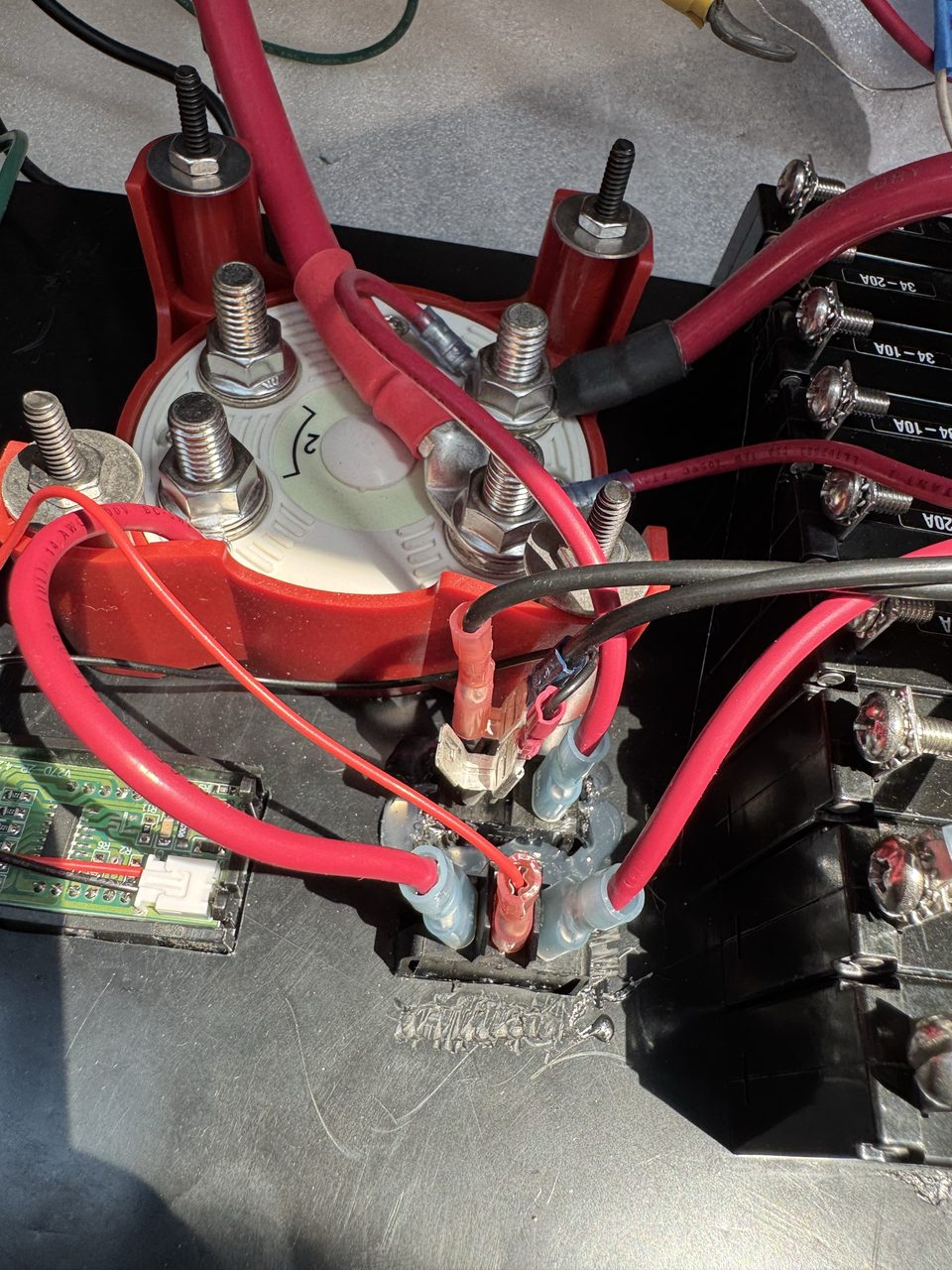
Inside, a new heavy positive cable now runs from the main fuse up to the battery switch on the back of the panel. That is the main artery: almost everything the boat does with 12 volts comes through it.
It lands on the unswitched side of the switch, which needs a word of explanation, because it is the part I would have got wrong if I had not gone looking.
Almost everything aboard should die when you turn the battery switch off and go home. A few things should not. The electronics now living in the battery compartment watch the batteries and keep the boat talking to the outside world, which is not a job they can do for part of the week. The important one is the bilge pump, which has to keep pumping whether anyone is aboard or not, because water does not wait for you to come back.
All of those are fed from the stud on the switch that the switch itself cannot reach.
The one thing I could not connect
The bilge pump was the thing I most wanted to finish, and it beat me for the smallest possible reason.
The spade terminals on the new panel are a size wider than the ones on the old panel. The connectors crimped onto the pump wiring are the old size. They do not push on. That is the entire problem.
I could have forced something. I have wire aboard, and there is always a way to join two conductors if you are willing to be ashamed of it later. This is a pump whose whole job is to work while nobody is looking at it, so it seemed like a poor candidate for a bodge.
The right connectors arrive tomorrow. It is a twenty-minute job once they do, and it is the first thing on the list.
An hour I would like back
The new panel has an indicator lamp that lights when the system is live. Mine did not light.
I got the meter out.
The readings were strange in a way I could not make sense of. Voltage where I expected it, at the incoming side of the battery switch. Voltage on the far side of the switch as well, with the switch off, only slightly lower — which should be impossible, because an open switch is a gap. I put that down to a bit of leakage through the indicators and moved on, uneasy about it.
Then I connected the wire I believed was the panel's return path, and the lamp still did not light. When I pulled that wire off again and measured it, I got a voltage that fell away slowly over several seconds, the way a charge drains out of something.
None of it added up. By that point I was four hours into the hottest part of a very hot day, thoroughly dehydrated, and aware that I was not thinking straight. A boat's electrical system is a poor thing to experiment on in that state. I made everything safe, left the panel unenergized, and came home to look at it again with a fresh head.
What a meter will actually tell you
The explanation is not exotic, and it wastes more time on boats than almost anything else.
A digital multimeter is enormously sensitive and draws essentially no current. It will report a voltage across almost any path at all: through an indicator lamp, through the panel's own metering, through damp, or simply between two cables lying next to each other in a bundle. None of those paths could carry enough current to light a lamp or turn a pump. They are quite enough to move a needle that costs nothing to move.
There is a straightforward answer to it. Better meters have a low-impedance mode that puts a small load across whatever you are measuring, and a phantom reading collapses to nothing while a real one sits exactly where it was. A twelve-volt test lamp from an auto parts store does the same job for five dollars, and one is going in the tool bag.
The slow decay was the tell I should have read. A conductor properly bonded to the negative side of the battery reads zero, instantly, always. One that drifts down over several seconds is not connected to anything at all.
Found in a photograph
I worked it out at the kitchen table, in a photograph I had taken for a completely different reason.
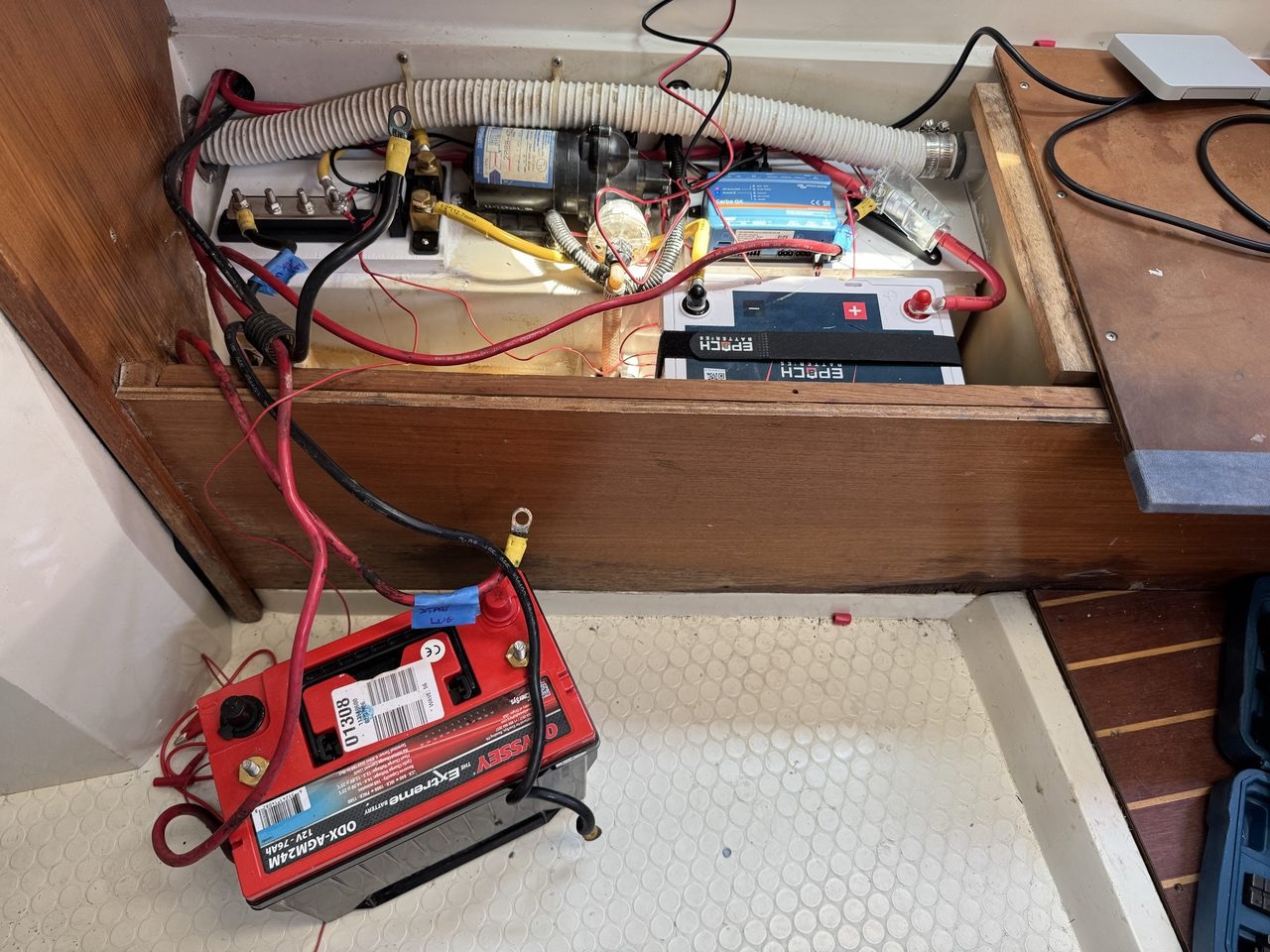
Electricity has to go out and come back. Every circuit on the boat sends its return to a common bar behind the panel, and one heavy cable is meant to carry all of it from that bar down to the battery compartment. Without that cable the bar is only a bar, connected to a great many things and to nothing that matters.
The cable exists. I had seen it that afternoon, bolted to the bar behind the panel, and my head filed it as done.
Its far end had never been near the battery compartment busbar. It used to land on the post of the engine-starting battery, which is where a boat of this age would put it. Before I started work I took every wire off both batteries, which is the first thing you do and not something I regret for a moment. Then I spent a long while with the meter working out which of them was which, because there were a great many and nothing about a black cable tells you where it goes. I found the two I was hunting for, labeled them, landed them, and moved on to the next thing.
That cable was still lying on the shelf waiting its turn, and its turn never came. It is in the photograph, terminal bare, inches from the bar it belongs on.
The lamp had been telling me the truth the whole afternoon. There was no circuit for it to complete. Every strange reading I took was the meter finding its way around the outside of a system that had no way home.
The part that stings slightly
There is a reason a new negative bar is sitting in the boat waiting to go in. The one behind the panel is too small to take a ring terminal the size that 2 AWG cable needs, and 2 AWG is what the new return run has to be. New bar, then new cable, then land the far end in the battery compartment. That was always the sequence.
Running short of time and wanting to see something work, I took what looked like a sensible shortcut. The old bar was still there with every branch still wired to it, so use that one today and fit the new one at the weekend.
The other half is worse in a quieter way. The busbar down in the battery compartment is one I put in a week ago. It was new. Nothing was attached to it that I had not attached myself, so two minutes' thought would have told me that the connection I was leaning on could not possibly exist yet. I never spent them.
That is a more interesting mistake than a forgotten label. I was not working from a bad record. I was working from an assumption about a piece of the boat I had built myself the previous weekend.
It cost an hour and no damage, which is a cheap price for it. I would rather have paid it here than somewhere it mattered more.
Where that leaves it
Friday, if I can get away, is the bilge pump. On its own that will achieve exactly nothing, which is worth being clear about. A pump wired to the back of the panel sends its return through the panel's negative bar, and that bar still has no road to the battery. Connect the pump to it and I have a pump that does not run.
Friday is really two jobs, then. The connectors arrive tomorrow, so the pump end of it is twenty minutes. The other end is a choice: fit the new bar and run the proper 2 AWG cable, which is not an evening's work, or put the old cable back onto the battery compartment busbar as a temporary measure and do the permanent version at the weekend.
It will be the temporary one, and it is going to have a label on it saying so.
Then Sunday and Monday, which is the real weekend's work. The bigger bar goes in behind the panel and the heavy cable gets landed properly. Then the rest of the wiring in the lazarette, pulled through as it should be this time, with the charger's data cable riding along with it.
With the battery compartment open anyway, the fresh water pump. It has been sitting in there leaking gently onto the shelf between the two batteries for longer than anybody knows, and it is the best explanation anyone has for the state the old battery cables were in. The new one arrived yesterday and is in the car.
The engine-starting battery is out on the shelf in the meantime, waiting on a new box because the old one had cracked. It goes back into a compartment I intend to have scrubbed white first, for the same reason as last time: on a boat where the open question is where the water is coming in, a clean surface is one you can read.