
She thought it was 1970
An hour before work. Swallow is on the internet and can be watched from home, once I found the reason she would not talk to it — and the new electrical panel is in far enough to have shore power running through it.
An hour before the working day, which is the shape most of these sessions take now.
Two things came out of it. Swallow is on the internet. And the new electrical panel is in far enough to have power running through it.
The wrong year
The first job was the cellular modem — the piece that lets the boat report in when nobody is aboard.
It did not go well for a while. The Cerbo, which is the small computer that runs the monitoring, could not see the modem at all. It had seen it before, which is the sort of detail that makes you doubt your own memory rather than the equipment. So I set the whole connection up again from scratch.
It still would not connect. Not for want of signal — it had signal. It simply refused, and it refused in a way that pointed squarely at the network or at my account details, both of which I checked twice and then a third time.
The problem was the date.
The Cerbo had come up believing it was some time in 1970, which is what a computer thinks when it has nothing better to go on. And every secure connection on the internet rests on a certificate, which is only valid between two dates. A machine that thinks it is 1970 looks at a perfectly good certificate, works out that it will not become valid for another fifty-odd years, and quite properly refuses to trust it.
So it was never the network and it was never the credentials. It was a clock. Setting the date correctly fixed it on the spot.
What I have not entirely made peace with is that it does not just ask the modem. The phone in my pocket knows the time because the network tells it. The Cerbo takes its time from the internet instead, which leaves it in a bind of a very particular kind.
I will take the lesson, because it travels. Any device that will not authenticate — a chartplotter, a router, a camera, anything that has been switched off for a while — check the date before you check anything else. It takes thirty seconds, and it is a common reason for a failure that looks like something else entirely.
What that buys
Rather a lot, for a morning.
The connection went up, and with it Swallow appeared on VRM — Victron's monitoring portal, and where all of this has been heading. From here on I can look at her from home: what the batteries are doing, what is charging, whether she is still plugged in.
Being online also meant both devices could update their own firmware, which they did, and that I could set the house battery's parameters properly rather than leaving the system guessing at them.
None of that is exciting to describe and all of it is the point. The Monitoring page is where it will live.
The panel
Then the panel.
Before touching any of it I disconnected the batteries completely. There is no version of this job worth doing with a live battery on the other side of the bulkhead.
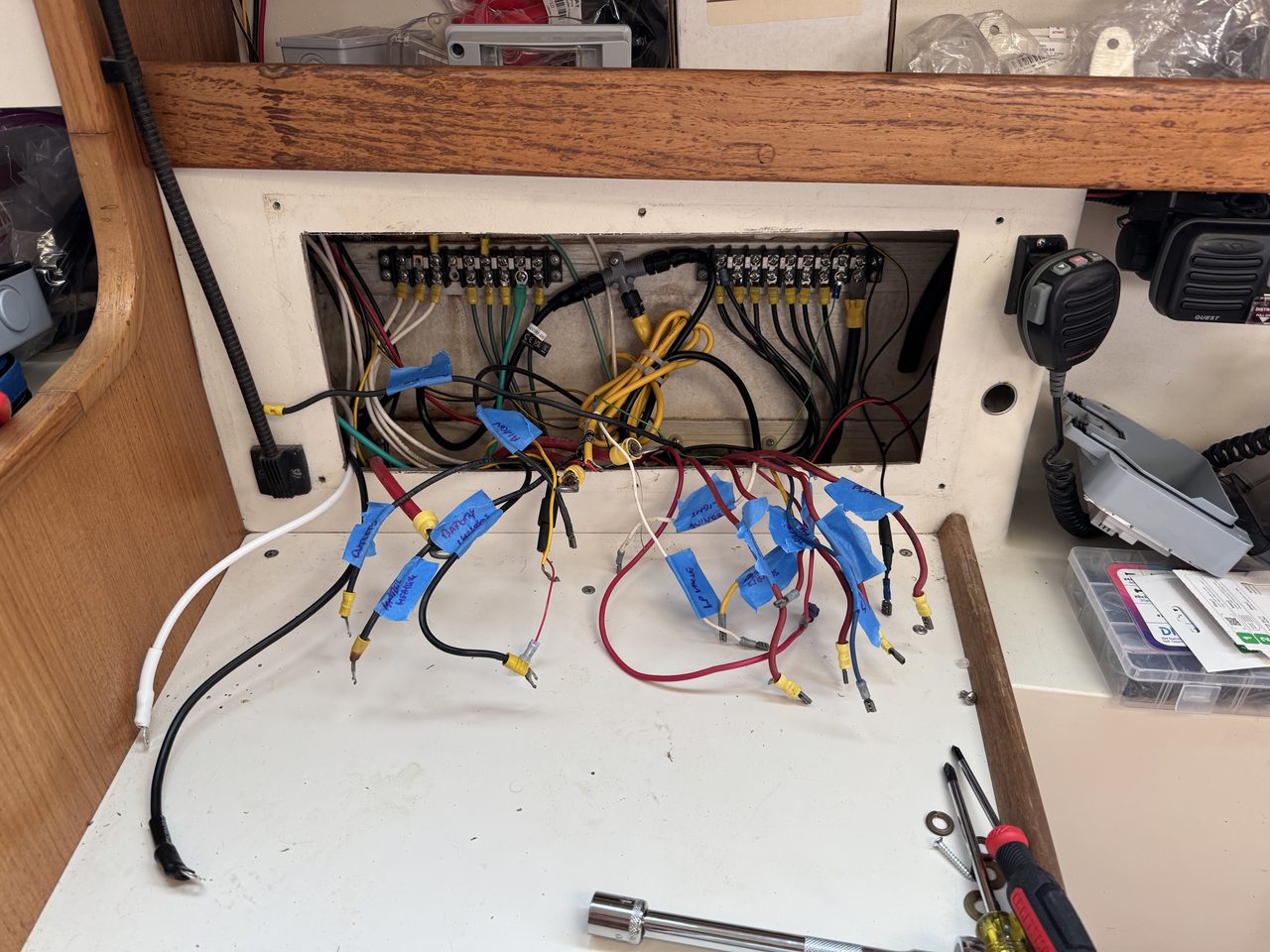
The old distribution panel came out, and it left behind the picture at the top of this entry: a rectangular hole with a great many wires hanging out of it, each one carrying a strip of blue tape with its job written on it in marker pen. Labeling those was the least interesting hour of the whole job and the one that decides how the next one goes. Thirty-three years of wiring is not color-coded to any scheme you would want to bet on, and the alternative to labeling is tracing — one wire at a time, with a meter, sitting on the floor.
What is connected so far is only the 120-volt side. Shore power comes in, through the new main breaker, and out to the sockets in the cabin. That was enough to put Eve, the portable air conditioner, back on the boat's own supply; she had spent the changeover running off a short extension cord, which is no longer needed.
Two lights
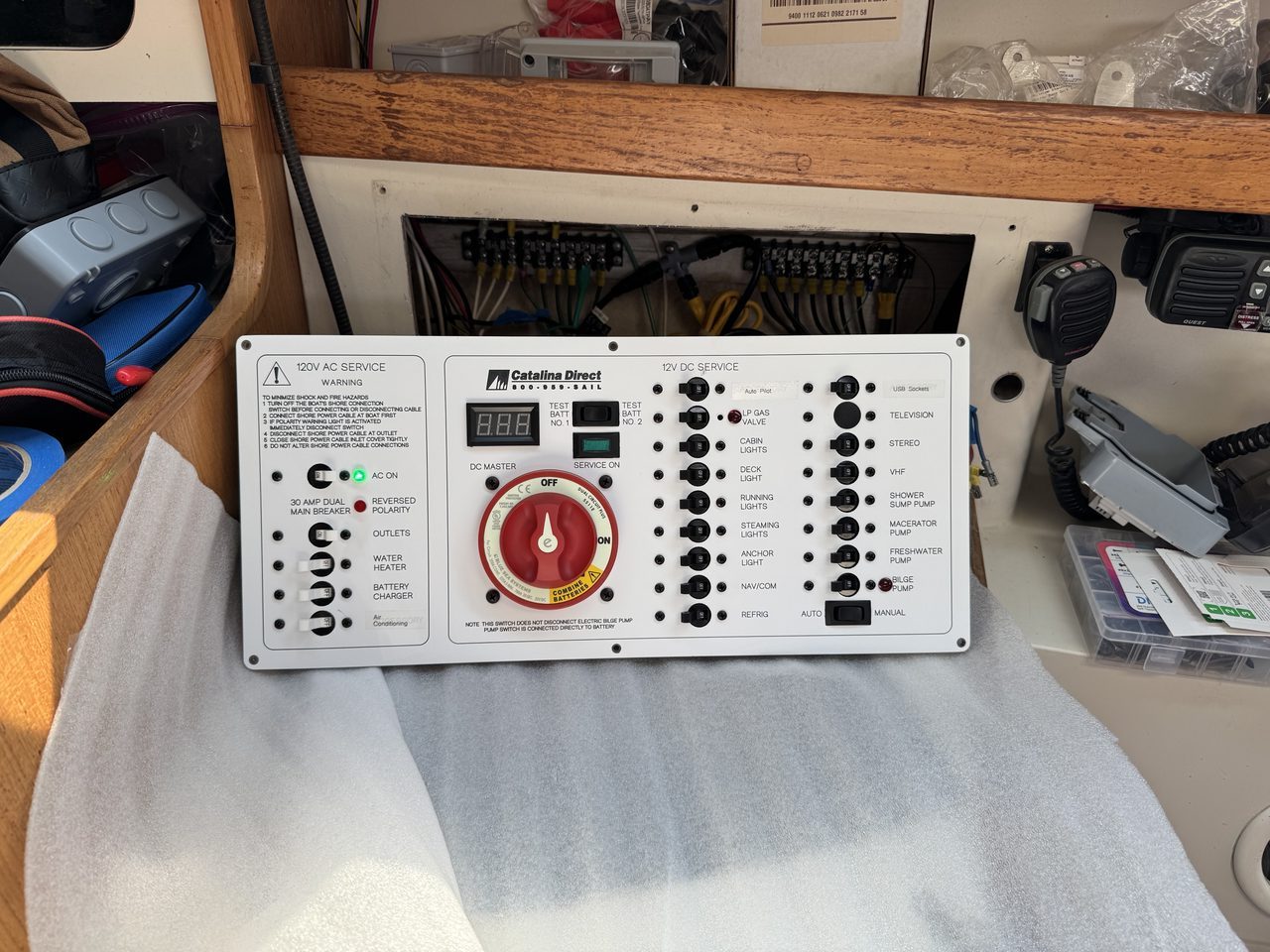
The green one on the AC side is lit, and it means only that shore power is reaching the panel. I enjoyed it more than a small green lamp really warrants.
The old panel had a green lamp in the same place. It never lit, because it did not work.
The red one beside it is the more interesting of the two. It indicates reversed polarity: hot and neutral arriving the wrong way round.
It is dark, which is what I want.
But here is the part worth the photograph. The red lamp on the old panel was dark too, and it told me nothing at all, because none of the lamps on that panel worked. From where you stand, a warning light that is off and a warning light that is broken look exactly the same.
So until this morning I had a boat that was probably wired the right way round. Now I have one I know is — and that is the first thing anything other than my own eyes has confirmed about the new inlet, the galvanic isolator and the heavier cable I pulled to replace the old one.
Why there is a light for that at all
It is a strange thing to need, when you stop and look at it. There is no reversed-polarity lamp in your kitchen. You have never once checked.
That is because a house is fed from one place by the city, wired once by somebody who was accountable for it, inspected, and then left alone. It is not going to be different on Tuesday.
A boat is fed from a post on the end of a dock. That post was wired by somebody, at some point, and has been repaired some number of times since by somebody else, and nobody aboard knows any of those people. Mine may well be perfect. But the entire point of a boat is that one day you tie up somewhere else and plug into their post, and then you have inherited their wiring along with their view.
Here is why it matters more afloat than it would ashore.
The neutral wire is the one everything is entitled to treat as harmless, because back on land it is tied to earth. On a boat, earth comes down the third pin of the shore cable and is then bonded to the engine, to the negative side of the batteries, and through those to the metal fittings that pass through the hull into the water.
So if hot and neutral are swapped at the post, the conductor running the length of the boat that everything treats as the safe one is now sitting at 120 volts — while the engine, the seacocks and the lake are all genuinely at earth potential. Nothing clever has to happen next. You only have to touch one of them while touching the other.
What saves you is that the main breaker on this panel disconnects both conductors rather than only the live one. With it off, nothing from the dock gets past it.
And the light still works with it off, because it reads the incoming supply rather than the panel. It will tell you the polarity is wrong whether or not you have switched anything on.
If it ever is lit, the move is to go straight back out, unplug from the dock, and go and find the harbormaster. It is their post, it is a real fault, and it is not only my problem — everybody else on that dock is plugging into the same row of them.
Where that leaves it
The remaining lamps, the ones on the 12-volt side, are dark as well. That is only because the batteries are disconnected, so there is nothing to read into it. They had counterparts on the old panel too, and those never lit either, for the same reason as everything else on it. Whether this set works is a question for tomorrow.
Some of those labeled wires will go straight back on. Some will be replaced. That is a decision per wire, on the condition of the wire and on what is at the other end of it, and it is not the kind of thing you can plan in advance — only leave room for.
The batteries are still disconnected, which sounds worse than it is. They are off the charger, but the charger has no power either, so nothing is being drained and nothing is being starved.
Tomorrow is the chargers. The old one comes out and two new ones go in: one for the lithium house battery, one for the lead-acid battery that starts the engine. Each has to be told which chemistry it is feeding before its cable goes anywhere near a terminal, because the two want noticeably different voltages, and a charger set for the wrong one does not fail loudly in an afternoon. It ruins the battery quietly, over months.
Then shore power through the new panel to both of them, and their output back to the batteries they belong to.
And after that Swallow can sit at her slip and tell me how she is getting on without my being there, which was the whole point of the morning.