
Stopped by a busbar
The panel I had nothing to cut last time got cut, and Eve is properly rigged at last. Then the main electrical panel swap stopped over a part I did not have, which turned out to be the right place to stop. The lithium house battery went in instead.
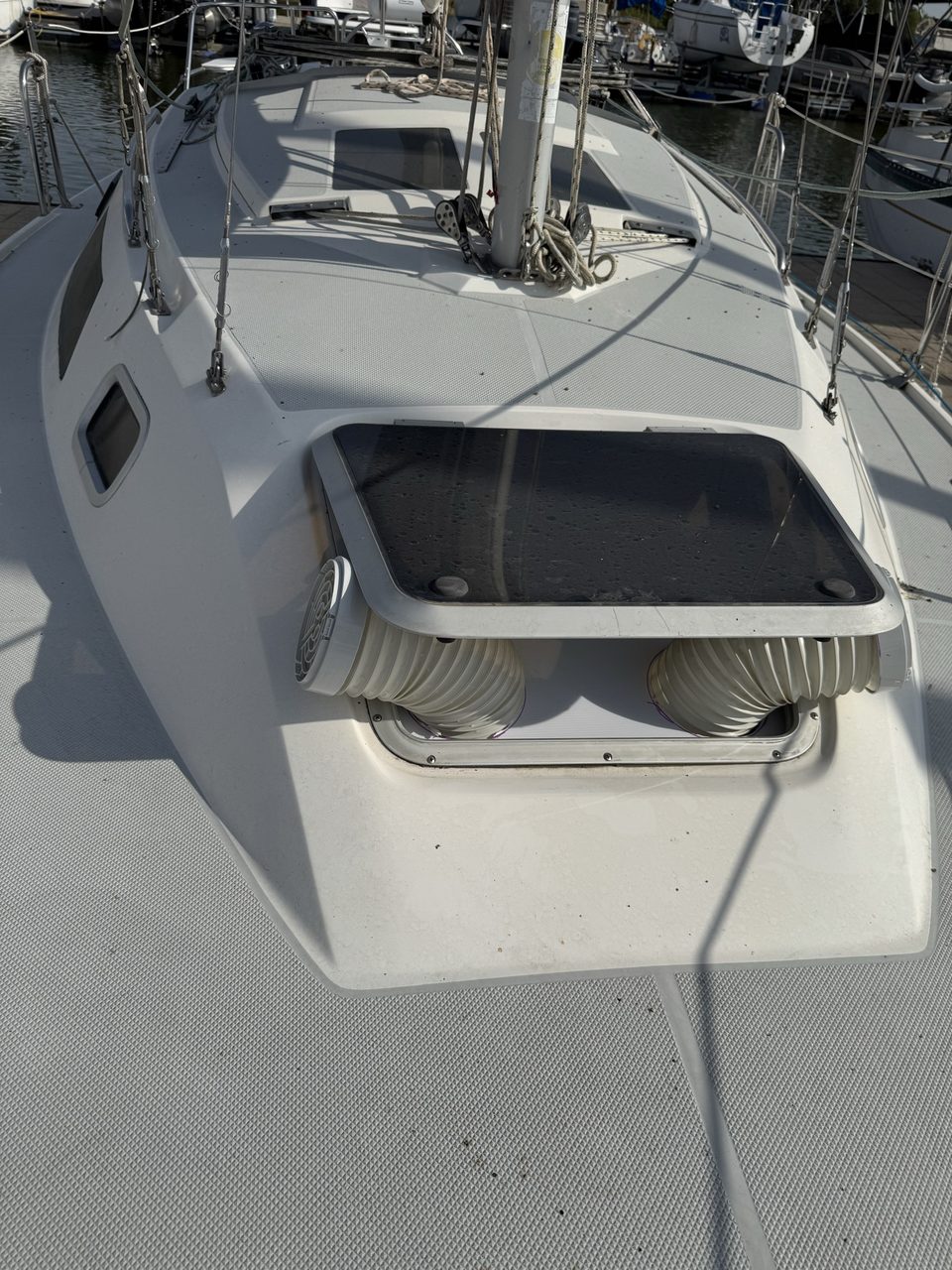
Last time I left the forward hatch open around two ducts, with a beach towel earmarked to fill the gap and a better idea I had nothing aboard to cut. I never did get to the towel.
This time I had the material: a sheet of corrugated plastic sign board, three feet by two, bigger than the hatch on every side and about fifteen dollars.
The whole job took an hour.
Cutting it
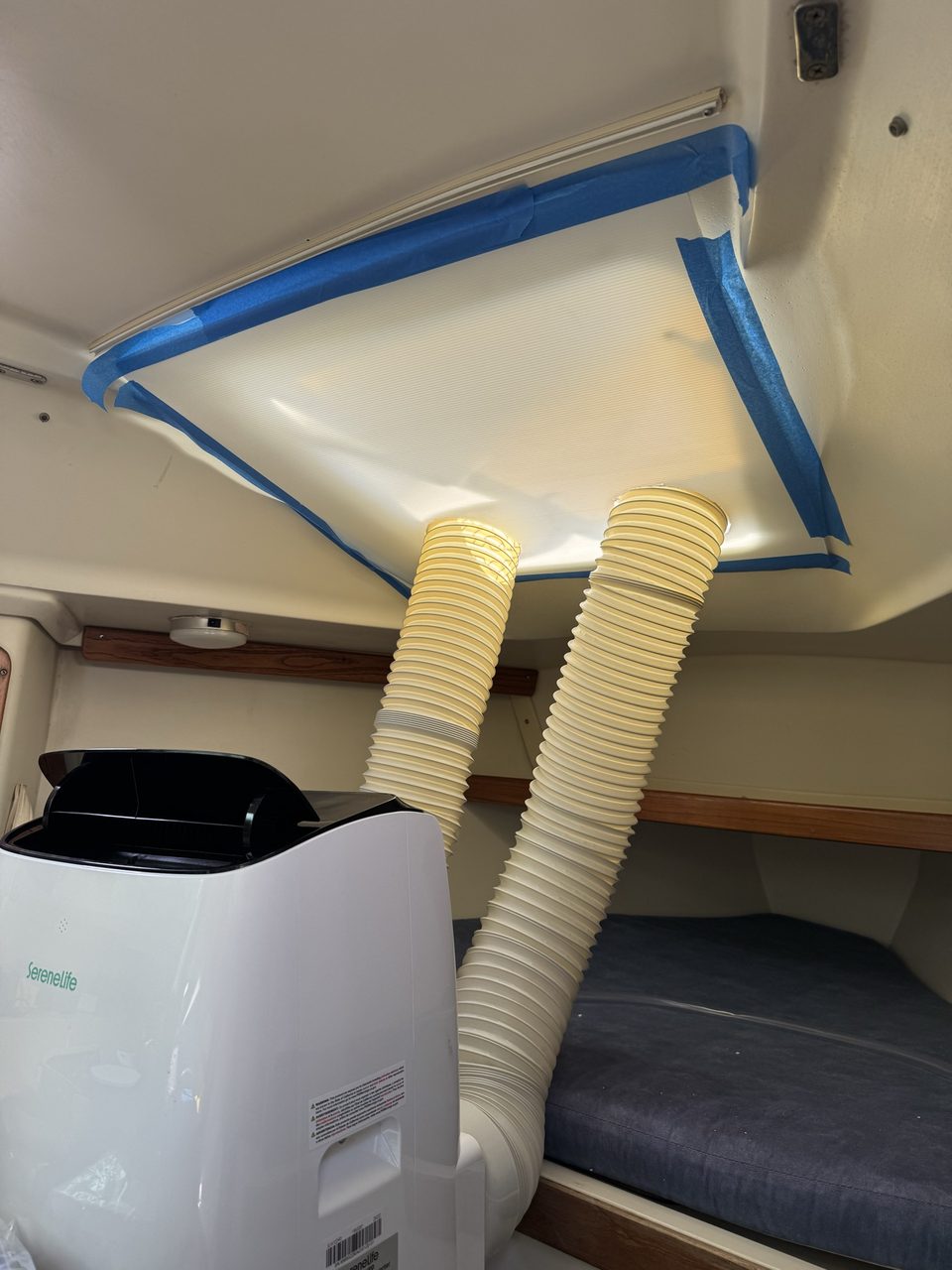
I held the board up against the deckhead and taped it there with masking tape, which is the trick worth passing on. Tape is reversible while you are still deciding. Nothing needs to be committed until the shape is right, and mine was not right first time.
Then out on deck to mark the holes. The hoses came with round collars that screw onto the ends, and those collars are exactly the diameter of the hose. So I took them off, set them down where I wanted each hose to come through, and drew round the inside of the ring. That gives you the hose, not the collar, which is a distinction that matters in a minute.
Then the board came down, the holes went in with a craft knife, and it went back up.
What holds it up
The reason the last attempt fell down was that the whole weight of a six-inch duct ended up hanging on the face of a lump of foam. Six-inch ducting is not heavy, but it is stiff, and stiff is worse. It levers.
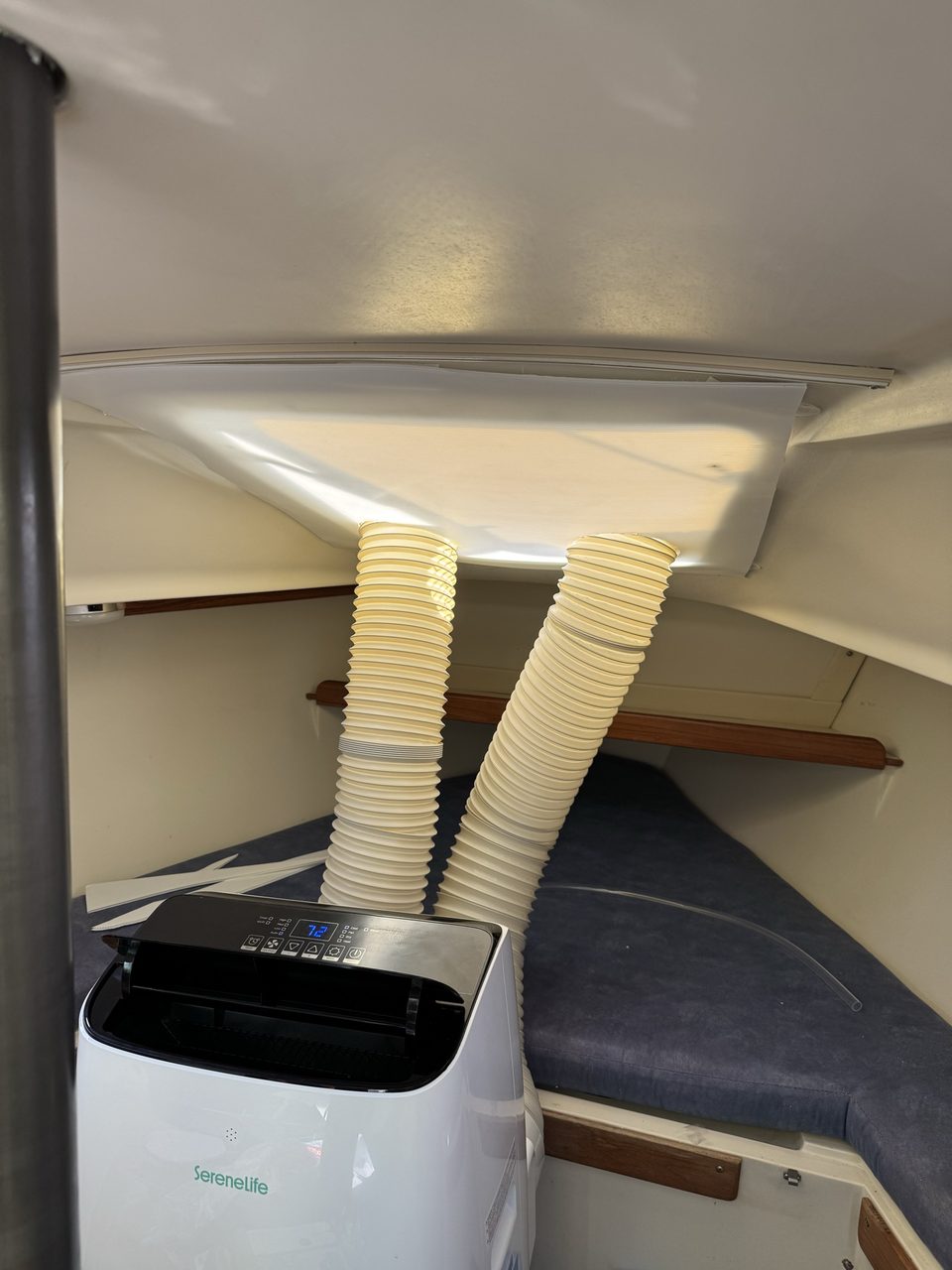
This time the hoses go up through the board and the collars go back on outside. The hole never has to be big enough to pass a collar, so it can be tight on the hose. Then I lowered the hatch lid gently until it came to rest on the two hoses.
That is the whole difference. The lid pins the hoses. The hoses hold the board. The velcro is only there to stop it wandering sideways and to keep it snug enough not to leak air.
The lid needs no force at all, which I had worried about. The struts on that hatch hold it wherever you put it, so it sits on the ducting under its own weight and no more.
That last job is the point of the board, and it is worth saying plainly. The hatch has to stay propped open for the ducting to pass through it, and without something filling what is left of the opening, Eve spends the day cooling the outside air falling in over the top of her. Blocking that gap is the whole reason there is a board up there at all.
Beaten at two o'clock
She held the cabin comfortable all morning, in a way that made the work pleasant rather than merely possible. By two the outside air had reached 106 and it was past her. Not unbearable below, but warm and getting warmer, and by then I had run out of water and most of my enthusiasm, so I called it there.
There are two fixes I have not made. The seal is not quite finished — a few more velcro tabs would help in one or two places, and I have a strip of foam padding to run inside the ring of them, which should close the last of it. The bigger one is the exhaust hose. It runs from the machine up through the cabin before it gets outside, and a bare exhaust duct radiates a good deal of the heat it is carrying straight back into the room you are trying to cool. A foil sleeve costs twenty dollars. Neither will beat 106, but between them they should move the hour at which she gives up.
The part I did not have
The plan for the afternoon was the main electrical panel: the thirty-three-year-old one comes out, the new one goes in, and the boat stops running its 120-volt supply through a chain of jumper wires that get hot.
I got as far as looking properly at what is behind it.
Every negative return in the boat comes back to a common busbar behind the panel, and from there a single cable runs down to the battery compartment. There has to be one, or none of it would work. The cable that is there is thinner than I would like, and part of the point of this rebuild is replacing it with 2 AWG, which is a good deal heavier.
Heavier cable needs bigger lugs on the ends of it, and bigger lugs need a bigger stud to land on. The busbar that is fitted has nothing on it that size. It is the sort of thing you cannot see until you are standing in front of it with the right question in mind.
A new one is ordered — twelve small screws for everything already landed there, and two proper studs, one for the heavy run down to the battery and one left over for whatever wants it later.
So the panel did not get changed, and I am pleased about where I stopped rather than sorry.
Here is why it mattered. The bilge pump on the new panel is fed from the new house battery, through its main fuse. Neither of those existed yet this morning. Pull the old panel out before the battery is in and the boat sits for a week with no automatic bilge pump, while I am still chasing where the rain gets in. I had a length of wire and a fuse holder in the bag for exactly that, and the better outcome is the one where I never open the bag.
An hour on an empty box
So the battery got the afternoon instead.
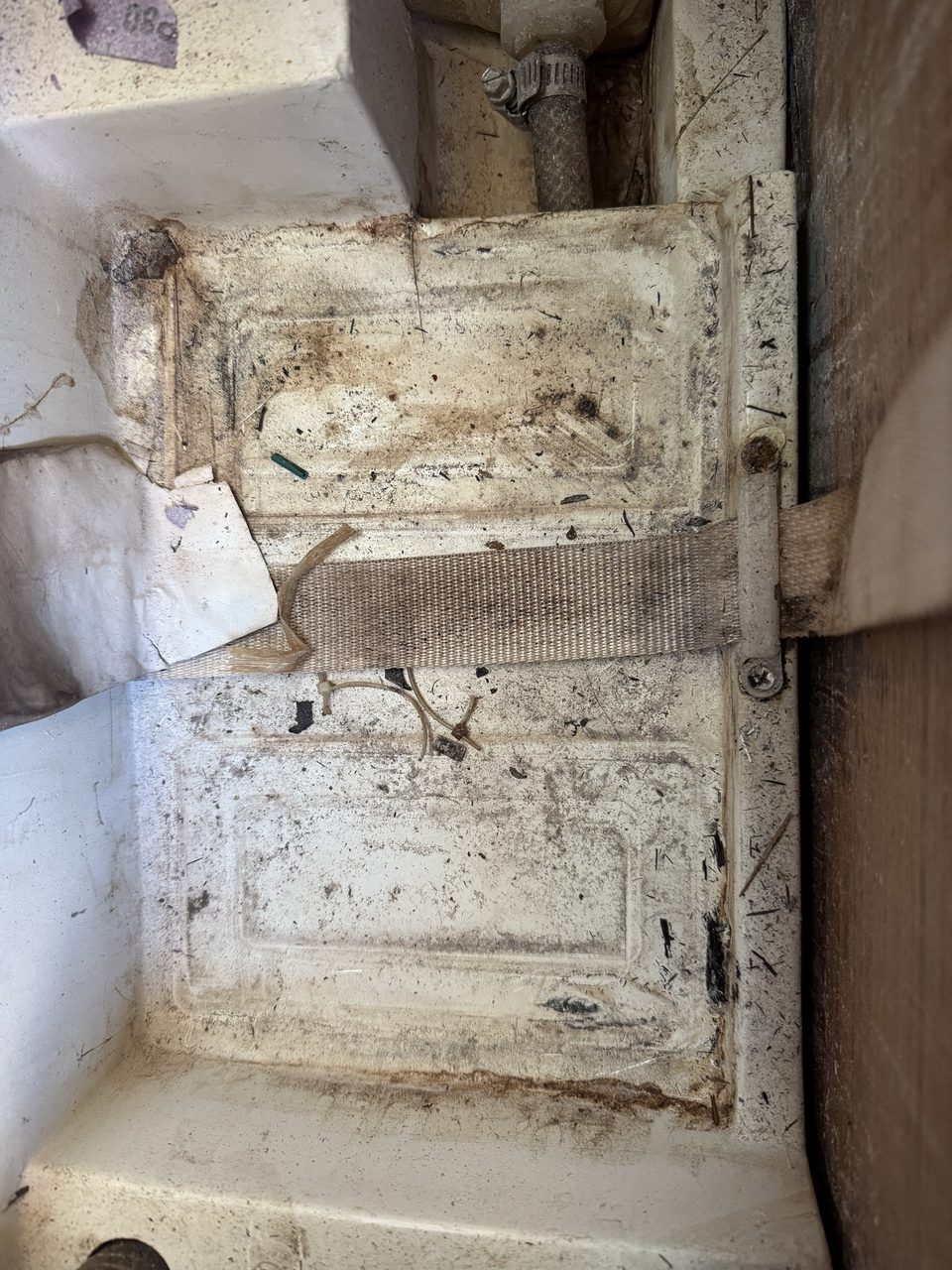
The old battery box came out altogether, along with the straps that were holding it. A lithium battery has no acid in it to leak, so it wants holding down rather than containing, and the box was only taking up room.
Then I spent an hour cleaning the space it left, which I am aware sounds like an hour badly spent. Nobody sees the bottom of a battery compartment. I will defend it anyway: a clean white surface is one you can read. On a boat where the open question is where rainwater is getting in, being able to tell new water from thirty years of old staining is worth an hour of scrubbing. It also felt like the right way to start.
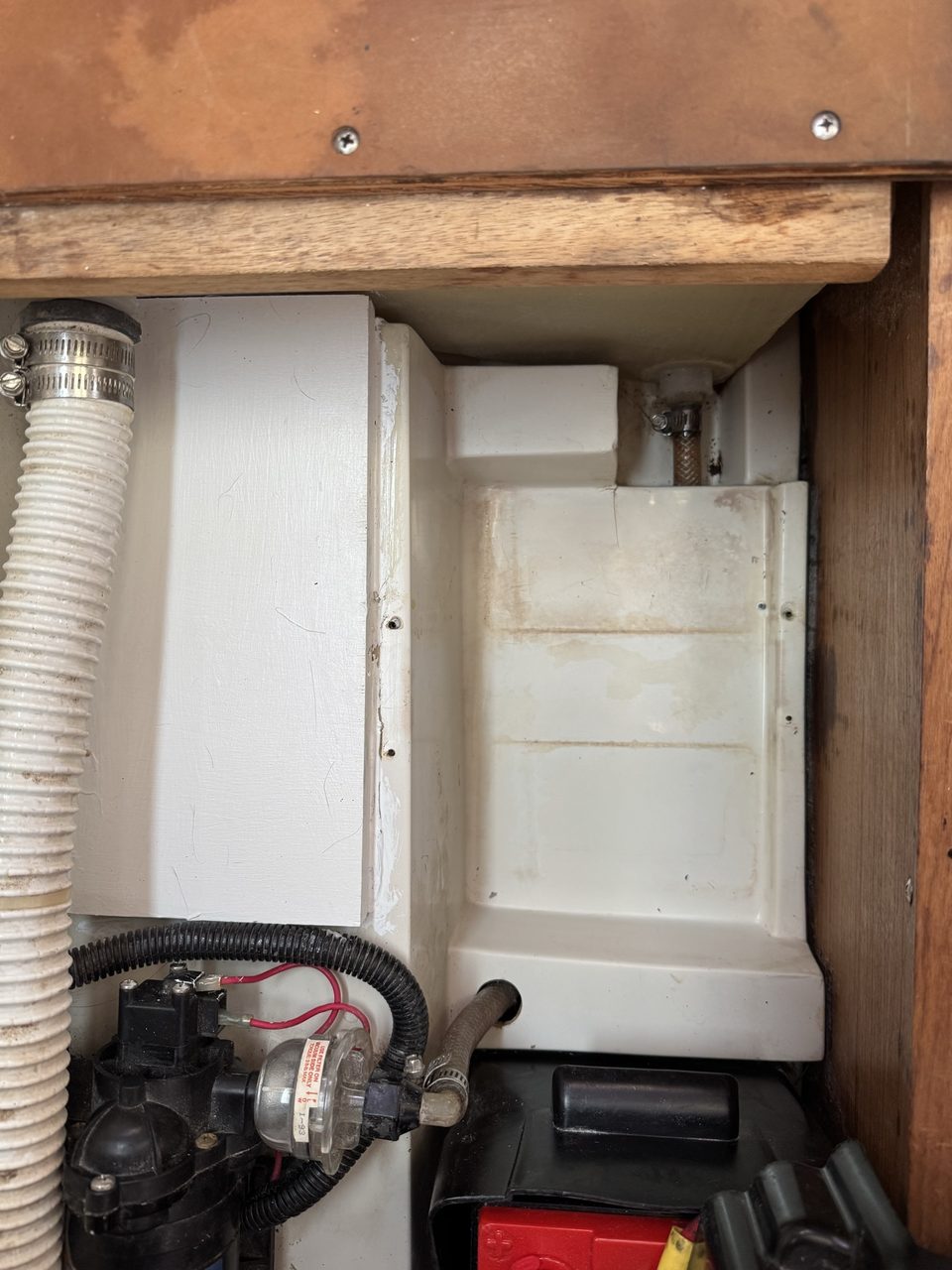
The first permanent thing
The tray screwed down to the floor, the battery went into it, and the straps went over.
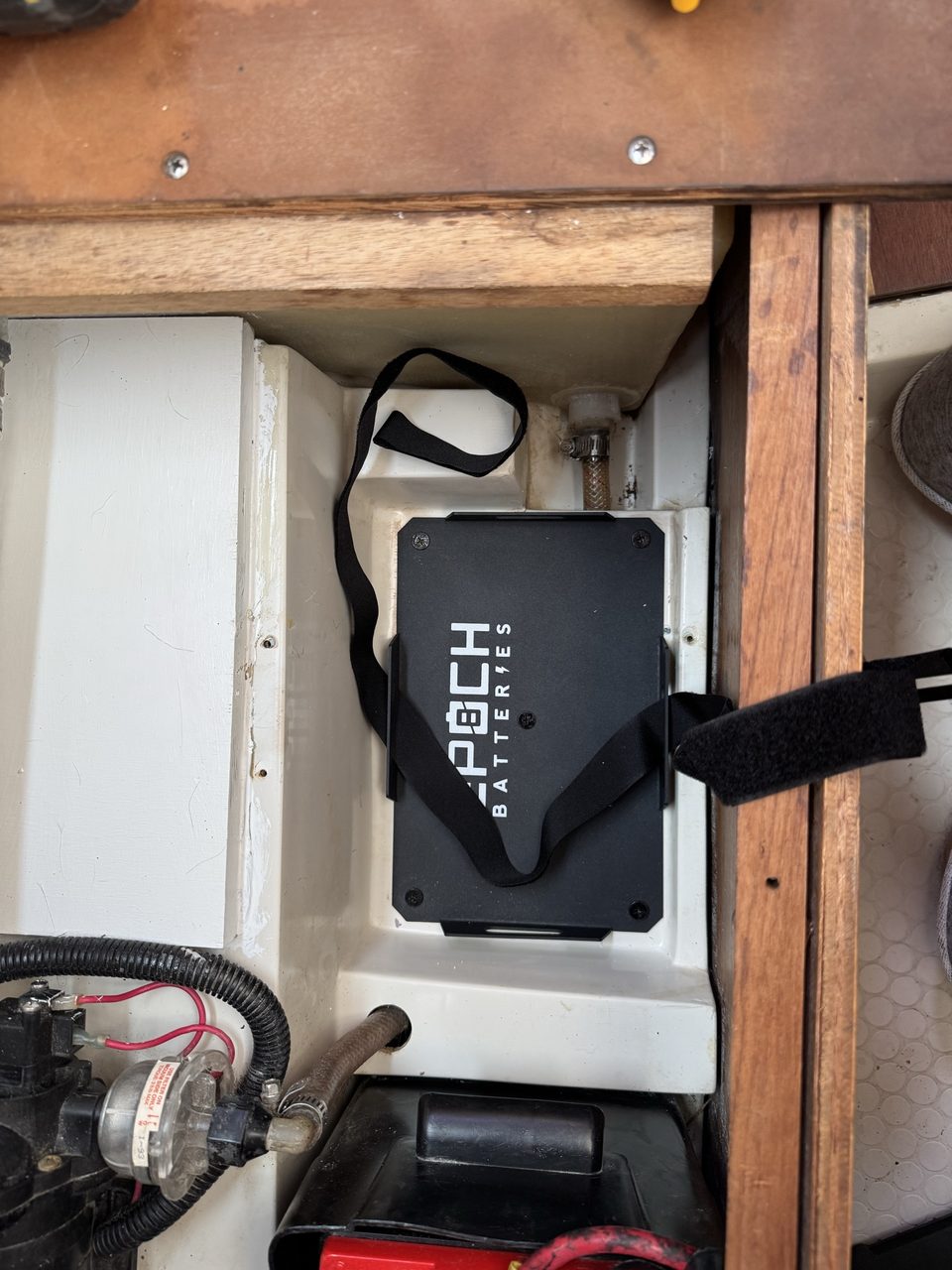
Then the wiring. A new heavy positive cable from the battery to its main fuse, which sits within a few inches of the terminal because that short length is the only piece of the whole system that nothing protects. A negative cable from the battery through the shunt — the thing that counts every amp in and out — and on to a new busbar.
I had gone back and forth for weeks about where the brain of the system should live, and settled it today by putting it in the battery compartment, with everything positive on one side and everything negative on the other and the bilge pump in between. Less chance of laying a spanner across two things that should not meet.
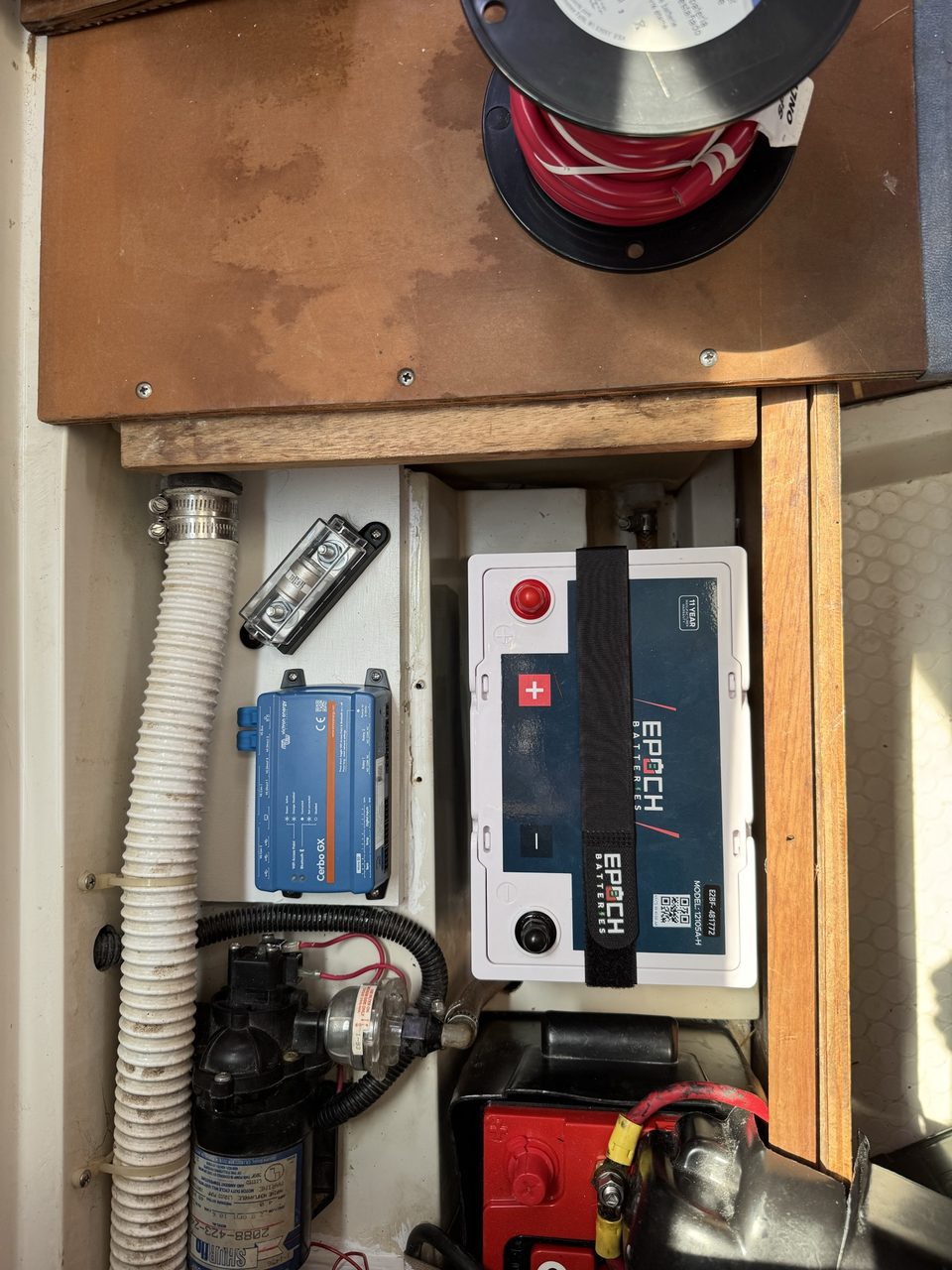
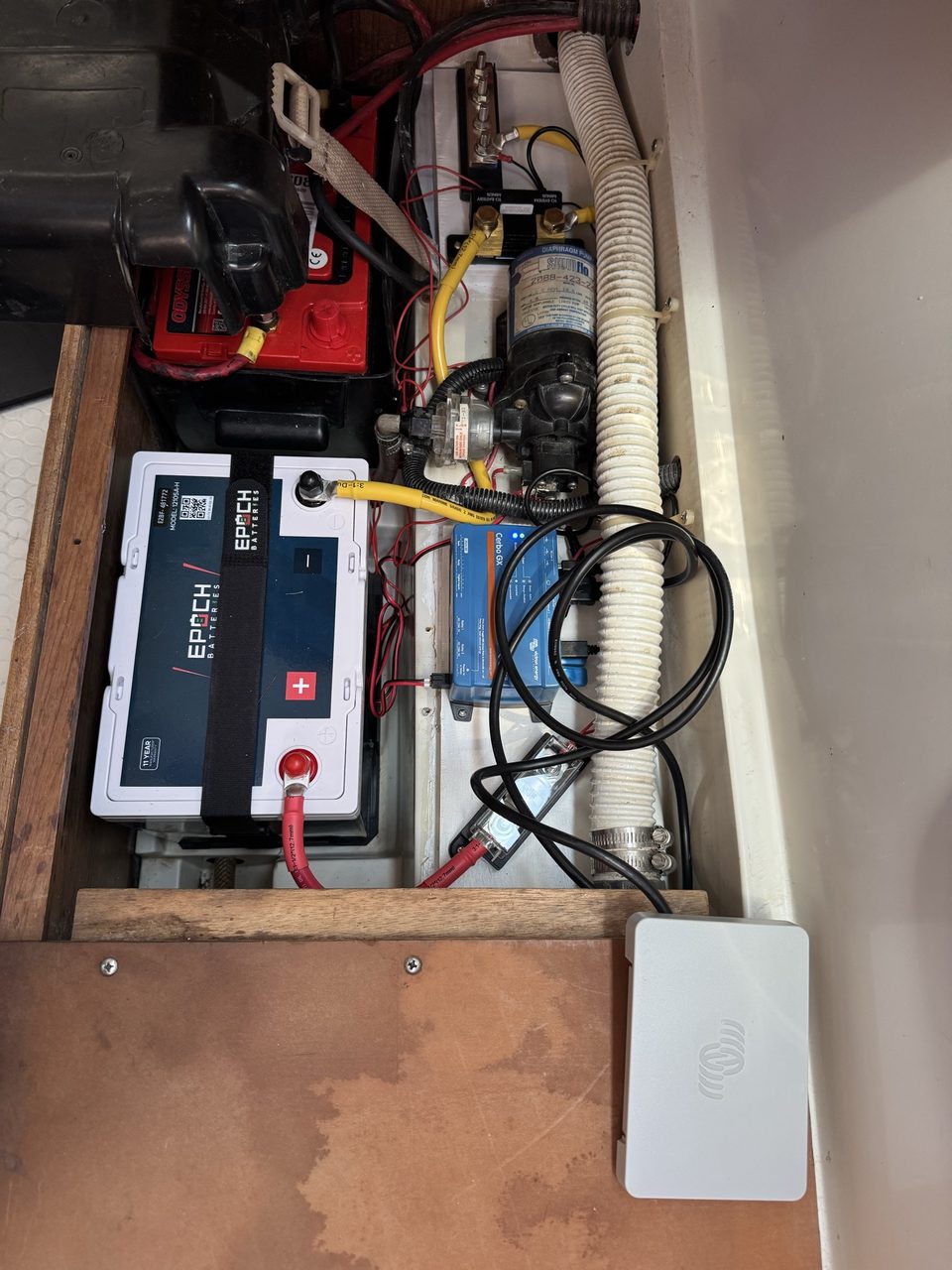
It worked. The Cerbo came up, found the shunt over its own cable, and I connected the little screen to it temporarily just to watch. It has to live up at the navigation station eventually, but this afternoon it sat on the lid of the compartment telling me the voltage of a battery three feet away.
That is the first time Swallow has been able to tell me anything about herself. It is also the first piece of the new electrical system that is not temporary — no clips, no sitting on a cushion, nothing to undo later. It is where it is going to stay.
Where that leaves it
I set out to change the main panel and did not change the main panel.
What went in instead is the thing the panel was going to be connected to, so the order is not wrong, only different from the one I had written down. The busbar arrives this week.
Eve is rigged properly, and Swallow has a house battery that was chosen for the boat she is going to be, not the one she was.