
No laser cannons
A day off, spent finding out that the plan for ducting the portable air conditioner through the port lights does not work. The forward hatch does. Also, after a long search, somebody to build the canvas.
The neighborhood lost power yesterday. It came back, and whatever it did on the way out took my speakers with it. The fault turned out to be two tiny 1,000 µF capacitors. Five dollars of parts and ten minutes with a soldering iron. I did not have the five dollars of parts.
They arrive tomorrow. A day of meetings without sound is not a day of meetings, so I gave up on the week a little early and drove out to the boat instead.
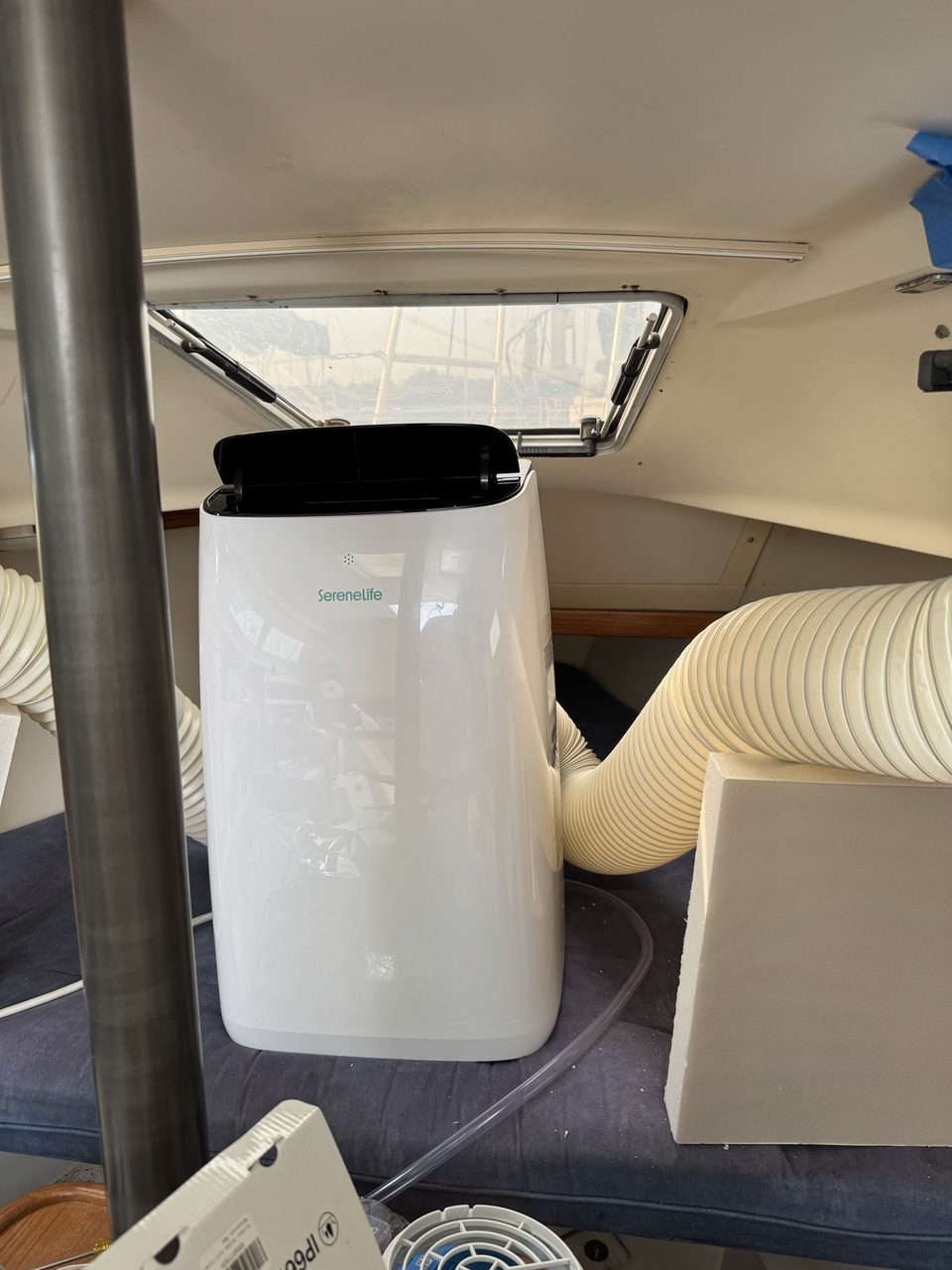
The portable air conditioner had arrived on Monday and was already aboard, waiting. I have named her Eve, after the robot in WALL-E: white, tapered, and faintly too pleased with herself. No laser cannons that I have found so far.
What she has to do
Eve is a stopgap. When the proper unit goes in this fall she comes off the boat altogether, and that fact sets almost every rule for how she gets installed.
Nothing about the installation can be permanent or leave a mark. She has two hoses, one drawing outside air across the condenser and the other blowing it back out again, so both have to reach the outside. Rigging her has to take minutes at the start of a working day and minutes again at the end of it, because anything that takes an hour each way will quietly stop happening by the third weekend. When she comes off, the boat has to close up weathertight behind her.
That last pair rules out the obvious answer. Anything held together with enough duct tape to be airtight takes forever to put up, longer to take down, and leaves adhesive on everything it touched.
The port light plan
The two aft port lights are about eight feet apart, one to port and one to starboard, with the whole coachroof between them. That is as far apart as two openings get on a boat this size, and the distance is the point: exhaust out of one and intake in through the other means Eve is never breathing her own hot discharge back in.
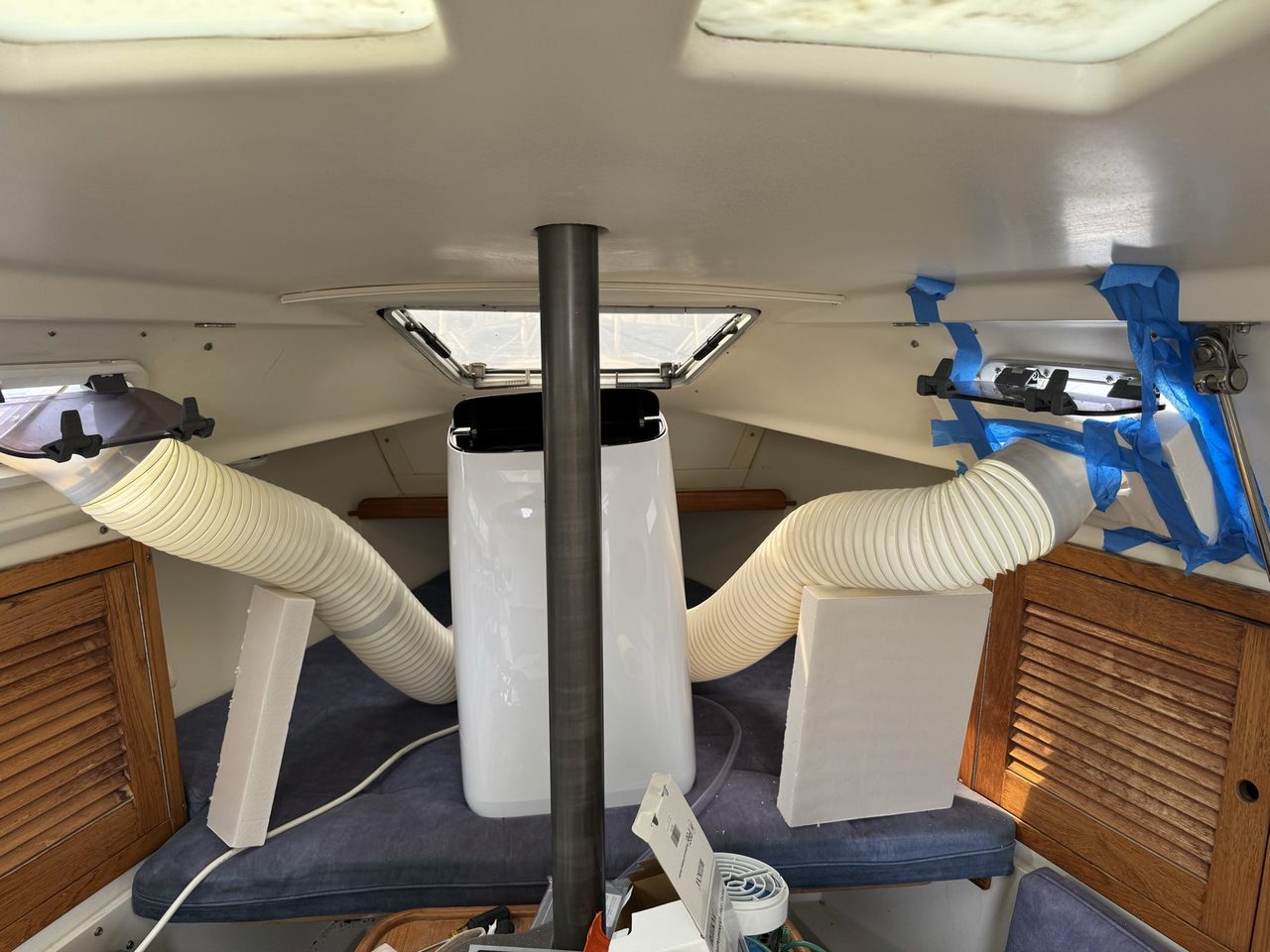
The hoses are six inches round and the port lights are oblong. I found adapters that convert one to the other, which I had not expected to exist and which felt like a good omen at the time.
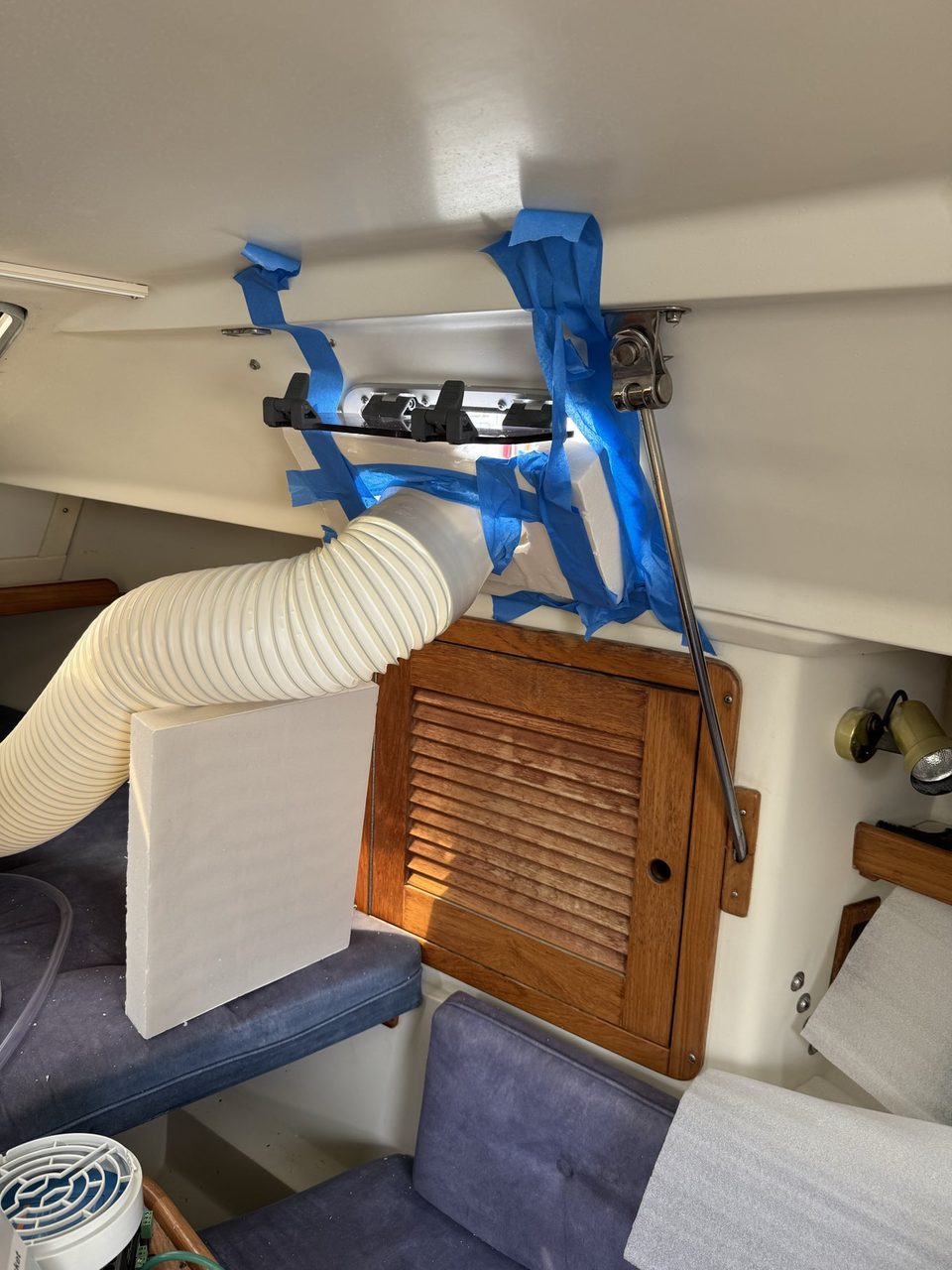
The rest was going to be two-inch polystyrene foam. Cut a block to fill each port light, hold it up with velcro command strips — they grip well and come away without a mark — then cut a hole through the middle and feed the oblong end of the ducting through. Tape the duct to the foam where it needs it, since the foam is the disposable part and tape on it costs nothing.
An hour to find out
It cooled the boat. Rigged exactly like this, Eve worked, and worked well, and that is worth saying before anything else.
Everything holding her there was wrong.
The adapters turned out to be short. An inch or so of the oblong section passes through the port light before the round part fouls the frame, which leaves almost nothing to grip. The entire weight of the hose then hangs on the face of the foam, and a six-inch duct is neither light nor willing to bend. The block came straight down. I propped it with a second piece of foam standing on the settee, which held, and which looked precisely as good as it sounds.
The port lights are the second problem. They hinge downward into the opening, so the flap sits inside the hole you are trying to fill. What has to be plugged is not a rectangle, it is a rectangle with a lid in it, and no amount of careful cutting produced a block that closed the space around it. There was always a gap along the top.
Cutting the blocks was worse than either. Expanded polystyrene does not cut so much as crumble, into thousands of static-charged beads that go everywhere and stick to everything, in a cabin whose every surface is already covered in tools. Shaping the faces took most of the morning. Clearing up afterward took an hour.
The port lights are abandoned, and I am not sorry about it.
The hatch was there the whole time
The forward hatch is a far larger opening, which means the full six-inch collars pass straight through it with no adapter involved at all. Both hoses go up through the one hatch. Nothing needs shaping to fit.
Eve moves down onto the berth as a result, and that turns out to matter on its own. From up on the settee she was firing cold air over the top of the cabin and skimming it along the deckhead to the back of the boat, missing the part of the cabin where I was actually standing. Down low it arrives where I am.
What the hatch costs me is the separation. Both hoses now leave through the same opening a foot apart instead of eight feet apart, which was the one thing the port light scheme had right. Hanging them so they point firmly in opposite directions once they are through should cover it, and hot air rises anyway, so the exhaust wants to go up and away and the intake wants to stay low.
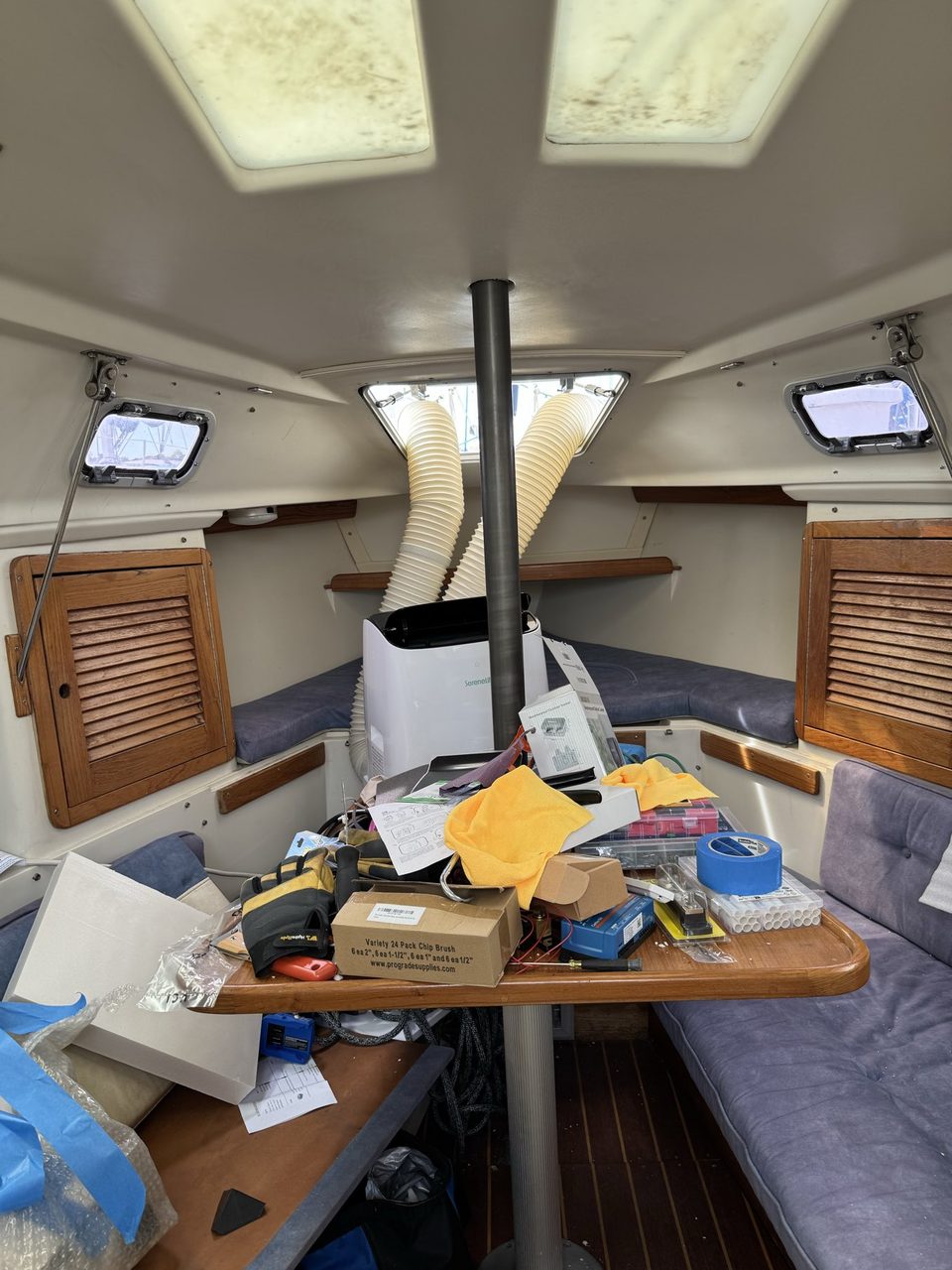
Sealing what is left of the opening is the question I have not answered. The proper solution is a flat panel cut to the trapezoid of the hatch with two round holes in it, velcroed up in the morning and pulled down in one movement at night. I have nothing aboard I can cut to shape for that yet. The short answer, which I will try first, is a large beach towel wedged into the opening and wrapped around the hoses, and it will not be tidy.
For one day it barely mattered. The hatch was wide open and there was a good breeze coming through it, which Eve was glad of. That stopped being true as the afternoon wore on and the breeze warmed up, at which point she was doing rather more work than she needed to.
What a refit actually looks like
The photograph above shows something I had not planned to publish and then decided I should. There is nowhere on a boat this size to put anything down. Every cabinet that is open for wiring access has its contents on a settee. Every tool that came aboard for one job is still out, because the job is not finished. All of it converges on the saloon table, which is the only flat surface left.
Somebody to build the canvas
The better news came earlier in the week, and it has been a long time coming.
Swallow has no bimini frame and no dodger frame. Nothing at all to hang canvas on. That makes this a different job from the usual one of re-covering a frame that already exists, and it needs a shop that bends and builds its own tube — where most canvas shops are sewing shops. Finding one has taken weeks, and the local sailmaker of fifty years standing is closing down as I look.
We have found them. Southfork Custom Canvas, in Lewisville, a few minutes from the boat. I have been over, met them and seen their work, and I liked both. Denise is putting the deal together and Roberto is doing the building.
A bimini, a dodger, and a connecting piece between them that closes the gap and makes the cockpit very nearly a full enclosure. We will not want that often in Texas. In weather that turns, it is the difference between sitting out in the cockpit and going below. A cover for the wheel and the instruments as well.
The one I am most pleased about
The last item is a new sail cover, and it is doing more work than its position on the list suggests.
The cover on Swallow now is tired. The zips are failing, which is the obvious problem, and the shape is wrong, which is the real one. It hangs below the boom. In any wind at all the mainsail slides off the boom and slumps into the bottom of the cover, where it presses against the seam and works its way out through it, which is a great deal of Texas sun on a sail that is supposed to be covered up.
It is also going to be in the way. The new dodger sits under the boom, and a cover that sags below the boom will drag across the top of it every time we tack.

The new one goes the other way up. The bag sits on top of the boom and zips along the top, and lazy jacks run from partway up the mast down to its sides, making a V either side of the sail. Drop the halyard and the mainsail falls into the bag, flaked, without anyone touching it. Zip it and walk away.
For a boat I intend to sail on my own, that removes most of the arriving-back sequence in one go. Nothing hangs below the boom either, so the dodger stays clear.
All of it is Sunbrella, in Royal Blue Tweed. Close to the blue already on the boat, with rather more life in it.
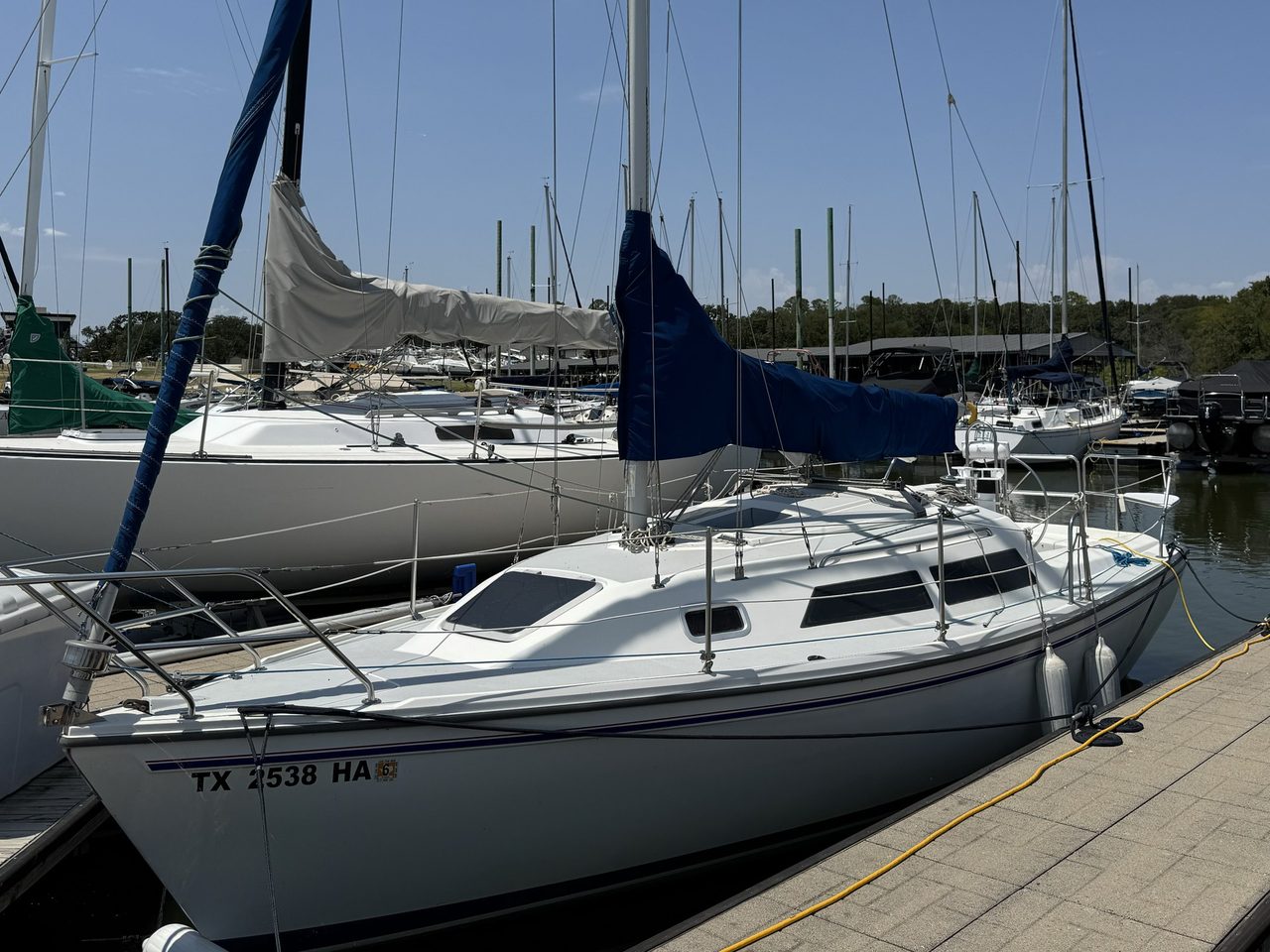

The frames are 316 stainless. I asked about the tube, because the spec everyone repeats is one inch and they are using seven-eighths. They brought both out and showed me. Their seven-eighths has a much heavier wall than their one-inch, which trades a little stiffness for a lot of strength at the fittings, and the fittings are where these frames actually fail — the tube crushes and the pin holes elongate. It is a choice, not a saving, and I was glad to have it explained rather than asserted.
A good deal of the design is borrowed. Marc, who sails a Catalina 270 called Aquaholic, has documented his own dodger and bimini on YouTube in real detail, and I have taken the best of it. Ours will not be a copy, since it is being patterned to Swallow. A lot of the thinking behind it is his. The grab handle across the front of the dodger frame is one of his, and it is exactly the sort of thing that costs nothing to include now and cannot be added later.
They are three or four weeks out on a full order book, which suits the calendar well enough. Canvas was the one item I had expected to miss the fall entirely.
Where that leaves it
By the count of jobs finished it was a thin day. One block of foam, cut wrong, thrown away.
The rest of it was finding things out: which plan fails and why, which one works, and who is going to build the canvas. I will take that.