

The shape of the problem
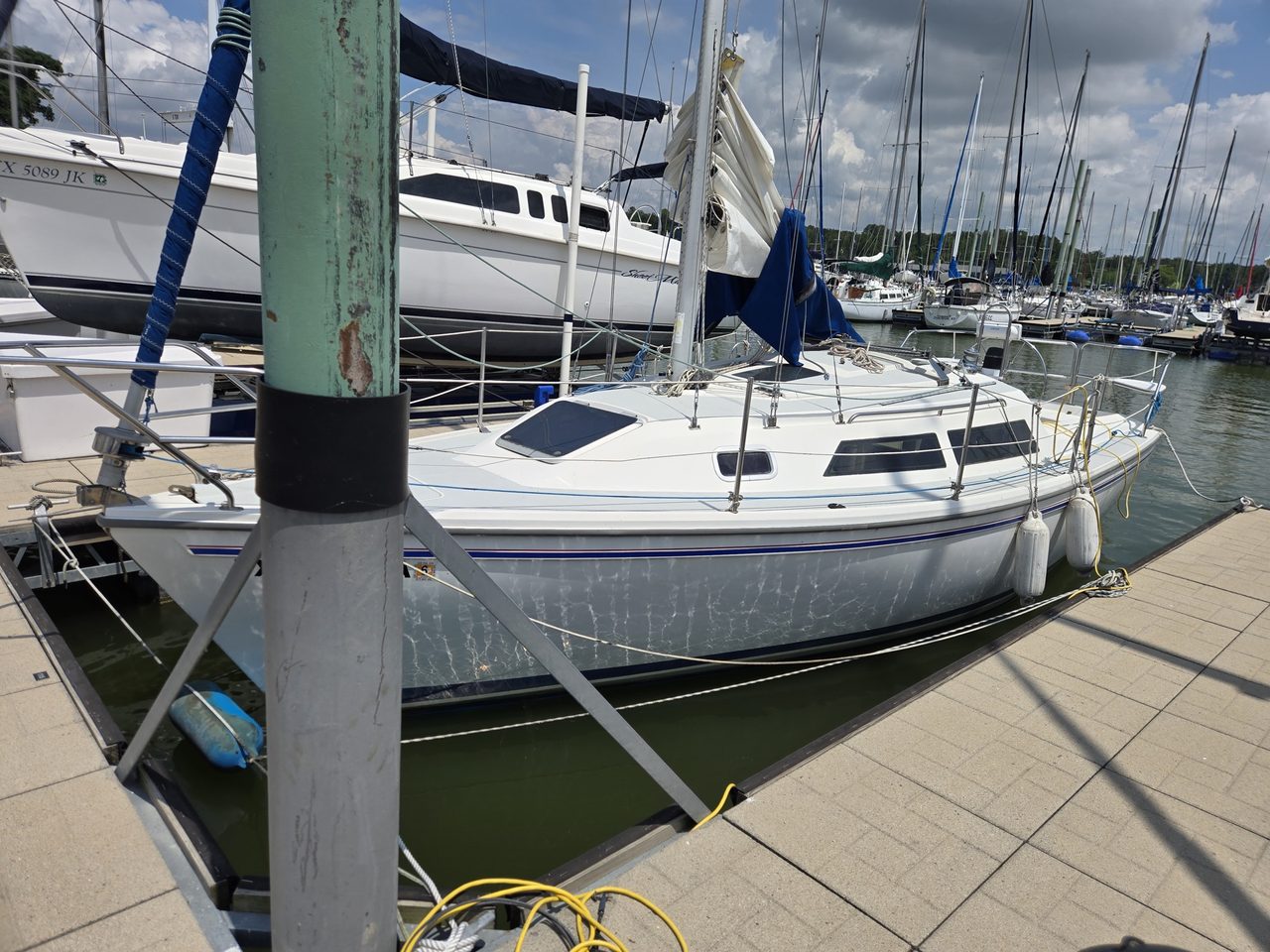
Nothing on Swallow is catastrophically wrong. That is worth saying first, because what follows is a long list and lists always read worse than they are.
The list falls into five kinds of problem.
What was added
The boat has gained a stereo, a charger, newer navigation electronics, a sump pump and an aftermarket air conditioner. Some of that work was done better than the rest. The electrical additions, in particular, were made one at a time without anyone later tidying the whole system. The re-glassing around the cabin sole and sump is much the same: not serious, but plainly amateur work, and it is not holding. Both are clean-up jobs rather than structural problems.
What is failing
Some things have simply reached the end of their lives. Many of the original circuit breakers show clear browning from heat and have to be treated as suspect. The shore-power inlet had cooked itself before we ever saw the boat, both batteries aboard when we bought her were dead, and the battery cables are badly corroded. The starter also sometimes declines to turn.
What was never added
Thirty-three years also leaves a list of improvements that nobody ever got around to. Midship cleats and a pair of aft cockpit winches are not repairs; they are the extra touches that make a small boat much easier to handle short-handed. Swallow never had them. She will.
Swallow has neither a dodger nor a bimini. That is not especially unusual for a lake boat used for short sails. In Texas, however, shelter from the scorching sun is no small favor.
What has changed
Standards have moved on since 1993. There is no requirement to rebuild an old boat every time the guidance changes, but a major refit is a good opportunity to bring the systems closer to current ABYC practice. A galvanic isolator and an equipment leakage circuit interrupter (ELCI) belong in that category: neither was part of the original installation, and both deserve consideration now that the shore-power system is being rebuilt.
What we cannot prove
Finally, there are things that may have been replaced but come with no record that they were. The standing rigging is the obvious example. It may be newer than the boat and in perfect condition. It may be original and thirty-three years old. With no evidence either way, we have to treat it with a high degree of suspicion.
Some of the work has a natural order. The upholstery is tired and holed in places, and the boards around the bottom of the cabin have clearly stood in water at some point. Neither is difficult to replace, but there is little sense in doing either while deck leaks are still dripping onto them. First stop the water; then make the cabin pretty.
Where the money goes
We bought a sound boat and then set about spending considerably more putting her right, which is either foolish or the entire point depending on how you look at it. We think it is the point. Swallow is a lovely boat to learn on and also a rehearsal — for a bigger boat, later, where the same mistakes would cost five times as much.
The most useful thing we have learned so far, and it was not free: unwinding thirty-three years of deferred maintenance costs something like two to three times what the boat cost to buy. Apply that ratio to a boat worth a quarter of a million dollars and the argument for paying a large premium for one that has genuinely been looked after becomes very easy to make.
The work
Shore power, from the dock in
The original inlet had a burnt live terminal, probably the result of a loose or corroded contact heating under load. We replaced the lot: a new SmartPlug inlet, the internal feed re-run in heavier 8 AWG cable with proper service loops at both ends, and a galvanic isolator fitted in the aft locker to stop the neighbours' boats quietly eating our anode through the shore ground.
Live and charging since 25 July.
The battery and DC rebuild
Both original batteries were completely dead when we took her over. The replacement plan is a full redesign rather than a swap: a lithium house bank, a separate AGM battery dedicated to starting, a Victron charger and monitoring system, and proper overcurrent protection throughout — which the boat has essentially never had.
Backing boards are epoxied in, the isolator is mounted, the batteries are aboard. The cabinets are out and staying out until every cable is run.
The part we are most pleased about is not really electrical. The monitoring system has spare inputs, one of which will go to a high-water float switch — so the boat will be able to tell us it is taking on water while we are sitting at home, which is not a message a boat has ever been able to send us before.
A new distribution panel
The original panel is the reason the A/C is currently forbidden. Its breakers are linked on the supply side by jumper wires rather than a bus bar, so the wire carrying the total load of everything downstream gets extremely hot — hot enough to smell the insulation after a few minutes of running the air conditioning.
The replacement lands every breaker on a proper common bus bar rated for the whole panel, which designs the problem out rather than patching it. Everything else waits behind this one.
Why she doesn't always start
Sometimes you turn the key and nothing happens. No crank, no click. Then the next day she starts perfectly. This is the single thing standing between us and using the boat, because an engine you cannot trust is worse than no engine at all — the worry is never leaving the dock, it is being in the middle of the lake and wanting to come back.
Suspicion currently falls on the starter trigger circuit and, most interestingly, on the gearbox neutral-safety switch — the only candidate that naturally explains a fault that comes and goes rather than steadily worsening.
Deck leaks
Three of them: the forward hatch, something above the port settee, and — the one that matters — water arriving in the engine tray after heavy rain, almost certainly through the emergency tiller port behind the pedestal.
This is where the corrosion came from, so it gets fixed before anything new gets installed.
Engine service, and a rough idle
Five hundred and forty-two hours in thirty-three years is barely run in, and in all likelihood some of this was done recently enough. But there is no record of any of it, and with no record the only safe assumption is that none of it happened. So: oil and filter, both fuel filters, the raw-water impeller, and the coolant drained and renewed.
She also shakes hard at idle. Eight hundred rpm is the correct idle speed for this engine, so that is a fault rather than a setting — and we found the idle had been wound up, which is presumably how the last owner lived with it. The shake is identical in gear and in neutral, which rules out the propeller and the shaft and points back at the engine. The leading suspect is a cylinder not pulling its weight, so a set of three new injectors is on order.
The cockpit engine panel
The original panel is worn past reading, its tachometer shows about 1,400 rpm at full throttle when the real figure is nearer 2,800, and the glow plugs and ignition share one fiddly key.
That tachometer is why this is really the first step in chasing the rough idle rather than a comfort upgrade: at present we have no trustworthy idea what the engine is doing at any throttle setting — and the propeller cannot be specified without a believable full-throttle figure either. The engine-bay blower has stopped working too, and the switch on this panel is the prime suspect, so it is worth doing this before anybody starts dismantling the blower.
It also has no audible alarm. The warning lights sit down by your feet, where a silent lamp telling you the oil pressure has gone is of no use whatsoever. The replacement has a two-tone buzzer and separate glow, ignition and start controls.
A short haul-out
The shaft anode is nearly gone, which is evidence of galvanic corrosion that has been quietly happening for some time. That is the job that will not wait.
While she is out: the new cutlass bearing goes in, and the shaft gets properly inspected — a propeller missing part of a blade has been running out of balance for years, and that load went somewhere. It is also the only opportunity to take the measurements the propeller shop needs, which is what puts a deadline in October.
The VHF
The set itself works, according to the previous owner. The antenna is simply disconnected. So with any luck this is reconnecting a cable and then persuading somebody to answer a radio check.
Worth doing early even so, because until it is done there is no way to call for help but a mobile phone, and no way to hear anybody else calling either — and every standard distress procedure begins with channel 16. A handheld is going aboard regardless. It works when the boat's electrics do not, it lives in a pocket, and it comes with you if you ever have to leave her.
Autopilot
A Raymarine wheel pilot, which is the single biggest unlock for sailing her short-handed. It is sitting in the cabin waiting for the panel swap and a $40 adapter cable.
Midship cleats
A spring line led from amidships is what lets one person stop a boat and hold her against a dock without anybody ashore to take a line. Swallow has cleats at the bow and the stern and nothing in between.
The pair we bought match the existing eight-inch cleats closely enough not to announce themselves. They are hollow-based, though, so they bring no backing of their own, and a midship spring cleat can end up carrying the whole weight of the boat — so this needs a proper fabricated backing plate rather than a handful of large washers. They land directly behind the upper cabinets, which lift out.
Cockpit winches
Two new Lewmar 30 two-speed winches came with Swallow and have never been fitted. They go on the cockpit coamings, where the headsail sheets can be worked from behind the wheel rather than from the cabin top — which is most of what makes sailing her alone pleasant instead of athletic.
As with the cleats, the real job is underneath: cardboard templates first, then backing cut from the same sheet of G10, and every hole over-drilled and filled with epoxy so that water can never reach the deck core.
The cabin sole
The floor flexes underfoot. The glasswork around the sole and the sump was done by somebody in a hurry at some point, and it is no longer holding. The fix is to grind back to sound laminate and lay up new glass rather than fill the cracks and hope.
It is also the sensible place to learn to do that, which is a real consideration: it is inside, out of the weather, hidden under a floorboard, and a poor result is a soft floor rather than a leak.
Shade
There is no bimini and no dodger, and — more to the point — no frame for either, so this is metalwork as well as sewing. We want the two designed together rather than one after the other, so they meet properly and can be closed in later.
On a Texas lake a dodger is not really about spray. Its roof takes the sun off the forward half of the cockpit, and with a roll-up front screen it turns into a scoop: Swallow lies pointing south at the dock and the breeze almost always arrives from the south, so there is a real draught to be caught rather than blocked.
The frame earns its keep a third way. A dodger gives you something solid to hold at the point where you step up onto the side deck, which is exactly where you want a handhold.
Music
The stereo dates from when people carried compact discs. One cockpit speaker is visibly damaged and the other does not work at all, and the two cabin speakers are loose boxes standing on a shelf — which is fine until she heels properly, at which point they become projectiles.
The replacements are already bought and none of them are grand: small mountable speakers for the cabin, a new pair for the cockpit, and an unglamorous head unit whose one important feature is that it takes music straight off a guest's phone. This is on the list because it is easy rather than because it matters.
Air conditioning
The existing unit is a sixteen-thousand BTU monster from the 1990s that, on close inspection in August, turned out not to be refrigerating at all — inlet and outlet pipes the same temperature, no condensation anywhere. It is also roughly twice the size the boat needs, and it draws more current than the dock can supply. The replacement is a 9,000 BTU variable-speed inverter unit that modulates instead of short-cycling, and the boat needs a proper air return built for it: at present the only path is a finger hole in a locker lid.
Moving this back is not a comfortable decision. It is a large job with a long list of expensive things to order, none of which gets us sailing any sooner, and even pushed hard behind the work that genuinely blocks everything else it would not be done before the weather turns — at which point we would not need it.
The cost is real: without air conditioning there is a limit to how long anyone can work inside the boat, so this slows down everything else on this page. We could not find a way around it.
A feathering propeller
The existing propeller is missing a sizeable piece of one blade. Rather than repair it, we are going to a feathering prop — much less drag under sail, and far better astern thrust, which is the thing that makes single-handed docking survivable.
Built to order, four to eight weeks, and specified from measurements you can only take with the prop off. Which sets a deadline in October.
Standing rigging
The wire is original. Thirty-three years old, no evidence it has ever been changed, and long past every published replacement guideline.
The awkward part is that the usual failure mode — corrosion inside the swaged fittings — is not visible from the outside, so no amount of looking at it can clear it. It gets replaced next time the mast is down.
That still leaves this season to get through, so a rigger goes up it first — not to decide whether to replace the wire, which is already decided, but to say whether it is sound enough to sail on in the meantime, and to look at the chainplates while there is a deck leak in that part of the boat.
Out of the water
The bottom paint is thin and there are around twenty small blisters, neither of which is alarming and both of which want doing while she is out anyway. The topsides get compounded and polished at the same time — thirty-three summers have left the gelcoat tired, and it is the cheapest job on this page that makes a boat look cared for. Her name goes on at the end of the same haul, once she is clean and dry.
The part worth paying attention to is the through-hulls. They are thirty-three years old, and the classic failure of old brass fittings is dezincification: the zinc leaches out of the alloy, the fitting continues to look perfectly sound, and then one day it crumbles. Given we already have evidence of galvanic activity on this boat, they get replaced with composite — and the replacements have to be properly rated, because there are plastic fittings on the market that look similar and are not.
The interior
The cushions are tired and holed in places, and the trim boards along the bottom of the cabin have plainly stood in water at some point. Neither is a difficult job. Both are pointless while the deck still leaks, so this waits at the back of the queue by design rather than by neglect.
Her name on the quarters
She had no name at all when we bought her, so Swallow is ours to put on. There is no usable transom to put it on — the back of the boat is a split walk-through with the swim ladder down the middle — so it goes on both quarters instead, which means two sets of letters rather than one.
Cut vinyl, from measurements taken while she is hauled out and clean, and proofed on paper first and judged from fifty feet away, because that is the distance anybody will actually read it from. Of everything on this page it is the only job we are deliberately saving to do as a family.
A refrigerator
Converting the icebox to refrigeration is a tidy job — a small compressor in the cupboard under the cooktop, and the evaporator through the wall it already shares with the icebox.
It sits here because the icebox genuinely does the job. Cold drinks and cold food are available today; they just involve buying ice and remembering to. This would be nicer rather than necessary, and it does not matter at all whether it happens this year or next.
Hot water
The water heater is roughly as old as the boat and is not heating. It looks air-bound, which would suggest the element was run dry at some point and tripped its safety cutout — in which case this might be a reset and a careful fill rather than a new tank. Nobody has actually looked yet, so the first job here is finding out, and only then deciding whether it is worth replacing.
It sits this far down because hot water simply is not urgent to us. It may also be less broken than it looks: the tank is plumbed into the engine's cooling loop, so an afternoon of motoring ought to produce hot water with no electricity involved at all.
An electric windlass
Hauling ground tackle by hand is entirely manageable on a lake, where the anchor mostly stays in its locker. It becomes a different proposition somewhere with tides, weather and a real reason to anchor.
It stays on the list mostly as a note to ourselves: once the autopilot and the refrigerator are wired, the new panel has no spare position left, so adding a windlass later would mean revisiting the panel as well.