
Shore power, from the dock in
Replacing a burnt inlet became a complete rebuild of the path that brings 120-volt power aboard.
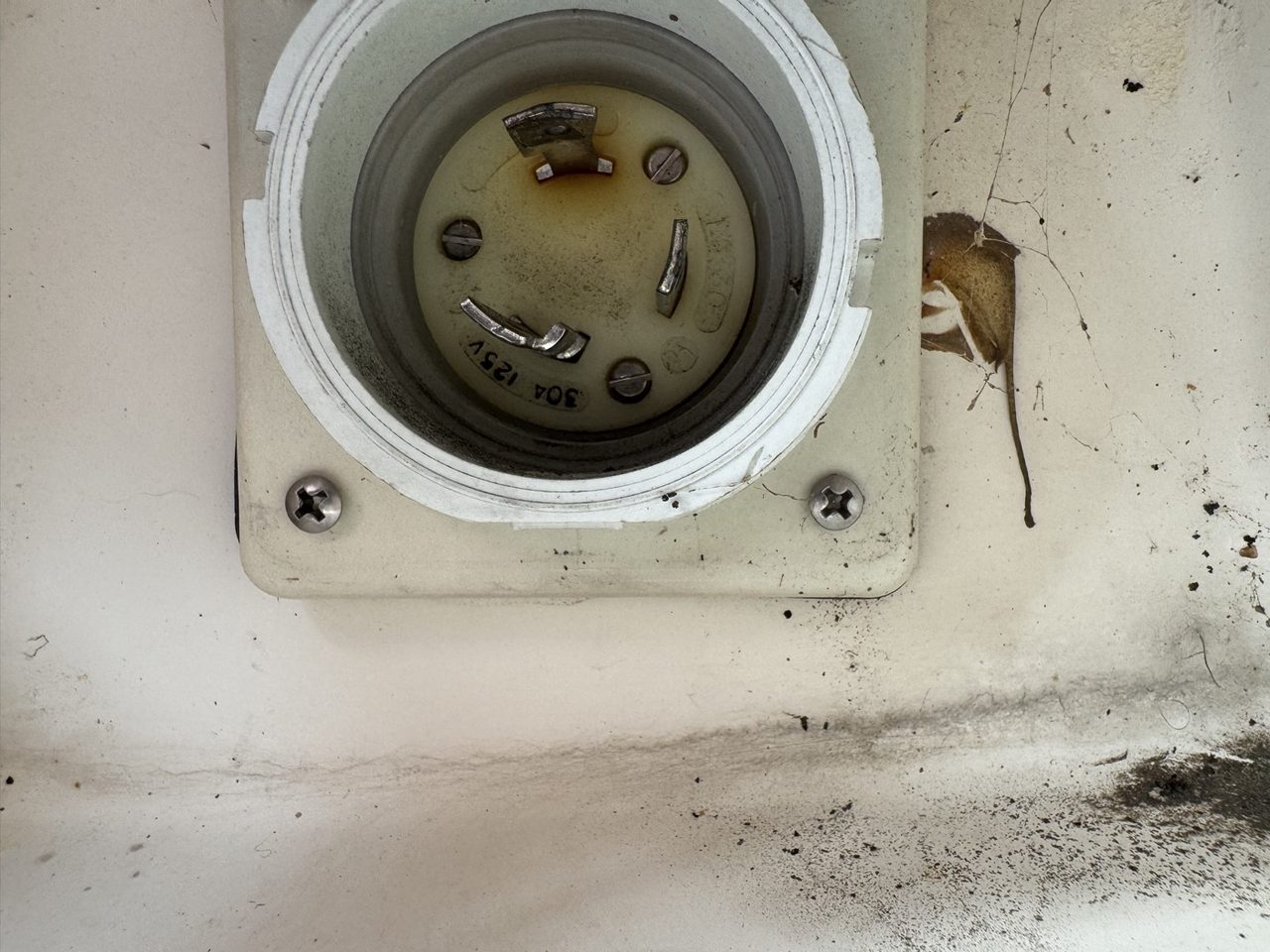
The problem
The original shore-power inlet had a burnt live terminal. On first inspection, I thought that it was the ground pin, which would have been much more alarming. Once the photograph was shown at full size, however, the molded markings settled the identification: ground is on the right, neutral is at lower left and the damaged blade at the top is live. That is a much more ordinary failure pattern. A loose or corroded contact carrying the boat's working load would develop resistance, turn that current into heat and steadily damage the inlet.
This is surprisingly common with the Marinco-style twist-lock connectors widely used on boats. As a connection loosens, the same working current passes through a smaller or poorer contact area. Resistance rises, heat builds and the connector can scorch or even catch fire. We decided to replace it with a SmartPlug connector.
The cable behind it had another, less dramatic problem: it was too short. There was no service loop at either end, so the inlet could not be pulled far enough out of the hull to work on it properly—not even far enough to disconnect it. The only sensible way to remove it was to cut the old cable and use it as a messenger to pull a new, longer cable through.
What we changed
If we were pulling new cable, we might as well improve it while we were there. Brand-new 8 AWG, three-conductor, fine-stranded, tinned marine cable went in, running from the SmartPlug inlet all the way to the distribution panel. Both ends now have enough service loop to bring the fittings into the open for inspection and future work.
Marine cable is not the Romex that you would use in a house. Given the same amount of copper, both carry current perfectly well; the difference is mechanical. A house stays still, so solid conductors are cheap and entirely suitable. A boat vibrates, flexes and requires cable to snake through lockers and around corners. Many fine strands tolerate that movement without work-hardening and fracturing as readily, while the tinning slows corrosion if moisture reaches the copper. A conductor that fails inside its insulation may remain invisible, and an intermittent connection under load can arc, melt insulation and start a fire. Fire is bad anywhere. On a boat, the escape route may be into the lake.
The earth conductor takes a deliberate detour through a galvanic isolator mounted in the aft locker. That leaves the protective earth intact for a real electrical fault but blocks the small galvanic currents that otherwise travel through the dock wiring and quietly consume the boat's anode.
The dock-side finish is a separate small project. The plan is to secure the permanent 50-foot cord along the dock with rubber-lined P-clips, keep the boat-side connection on a short removable pigtail and shelter the joint inside a rain shield. That work remains to be completed.
Where it landed
Shore power went live on 25 July. The charger came up and the batteries began charging; the inlet, new feed and galvanic isolator all worked as intended.
The permanent distribution-panel replacement is a separate project. Until that is complete, the old panel remains the weak point and the air conditioner stays off.
From the Captain's Log
The evening that shore power first went live also produced a useful lesson involving a closed seacock, an air-locked pump and several increasingly elaborate theories.