She's ours
A short search for something that would get me out of the office ended with a Sunday sea trial, one key and a boat of our own.
Something of my own
Martha and I had been talking about the fact that I spend rather too much time working. Retirement is not close at hand, but it is closer than it has ever been, and I need to make a deliberate effort to spend some of my time away from work.
I have a pet project that I enjoy enormously, but it is computer-centric. It keeps me in the same office, in front of the same screens, still working and thinking rather than doing. It is enjoyable, but it is not relaxing. I needed something that I could do in small pieces of time but that would still consume a decent amount of it; something that I would have to plan around; something that would take me outside and make me put down both the computer and the phone.
Martha already has that in her garden. She loves working in it and does a wonderful job of it. I am not a gardener, although I enjoy the garden that she has made. Sometimes I go outside and sit with her while she works, and it makes me smile to be beside her while she is doing her thing. Sailing is not Martha's thing in quite the same way, but she knows that it is mine. From time to time she is more than happy to come with me and be beside me while I do it. Mostly, we both wanted me to have a thing of my own.
A lake house that could happen now
The idea of owning a boat had been with us for a while, but always as something that we might do one day. We had also been toying with the idea of buying land near a lake: a peaceful place for retirement, with enough room for Martha to grow a proper garden and far enough away from the bustle that seems unavoidable while you are working. We began seriously looking at land around Lake Texoma. It is beautiful there.
The trouble was that we had worked hard to pay off our mortgage and we like where we live. We both believe that there will come a time when we want to move, but we hope that it is not soon. Buying another house that we would visit only at weekends made little sense.
That led to a different thought. What if the lake house were not a house at all? What if we spent a fraction of that money on a boat that we could stay aboard for a weekend? We would have the lake house and the boat in one, without waiting for retirement to arrive. It would be a now thing, not a then thing.
We did not have a great pile of spare money to throw at a passing idea. The proposition was therefore simple: could we buy something with the cash that we had, use it now and fix what needed fixing ourselves? That was the spirit in which the search began.
Two lakes for different reasons
Lake Texoma was the obvious first choice. It is a little way from home, but the drive is mostly a straight run up US 75. The lake is large enough that you can do a substantial amount of sailing before you have sailed everywhere, and it has the beauty and peace that had drawn us to the land idea in the first place.
We also looked at the lakes around DFW. One visit took us to Lake Grapevine, where the marina sat behind locked doors. We could not see the boats, and although there was plenty of commercial activity, the place felt rather stand-offish.
Lake Lewisville was different. We visited Dallas Corinthian Yacht Club and were welcomed, shown around and made to feel that we could easily become part of the place. It was very clearly a community of people who loved sailing and loved boats. Lewisville is not as large as Texoma, but it is not a small lake, and it was beautiful there too. We looked at several other possibilities, but none spoke to us in quite the same way.
That left two choices. Texoma had size, peace and open water. Lewisville had community, friendliness and spirit. Moving a modestly priced boat between lakes could cost thousands of dollars, which made little sense in the context of the purchase. We decided that our home lake would be whichever of the two held the right boat.
Small enough, but not too small
The brief was short: wheel steering, standing headroom, an inboard diesel and a cabin that Martha would actually want to spend an afternoon in.
There was a little more behind it than that. Martha was keen that we should not buy anything too large. It needed to be a boat that I could handle comfortably and, just as important, one that she felt comfortable with me handling. I wanted something large enough to contain the systems that we would find on a bigger cruising boat. Learning to operate, maintain and repair those systems would transfer to a larger boat later, or to another bareboat vacation where we would be responsible for one.
My research suggested that about 28 feet was the lower edge of that territory. The Catalina 28 became the leading candidate, although we also looked at boats from Beneteau and Hunter. The Catalina 30 was an obvious possibility too: it is one of the most popular sailboats ever built, but we did not find one in good condition during our rather short search.
We found one particularly good Catalina 28 and lost it just before we could see it.
Finding the Catalina 270
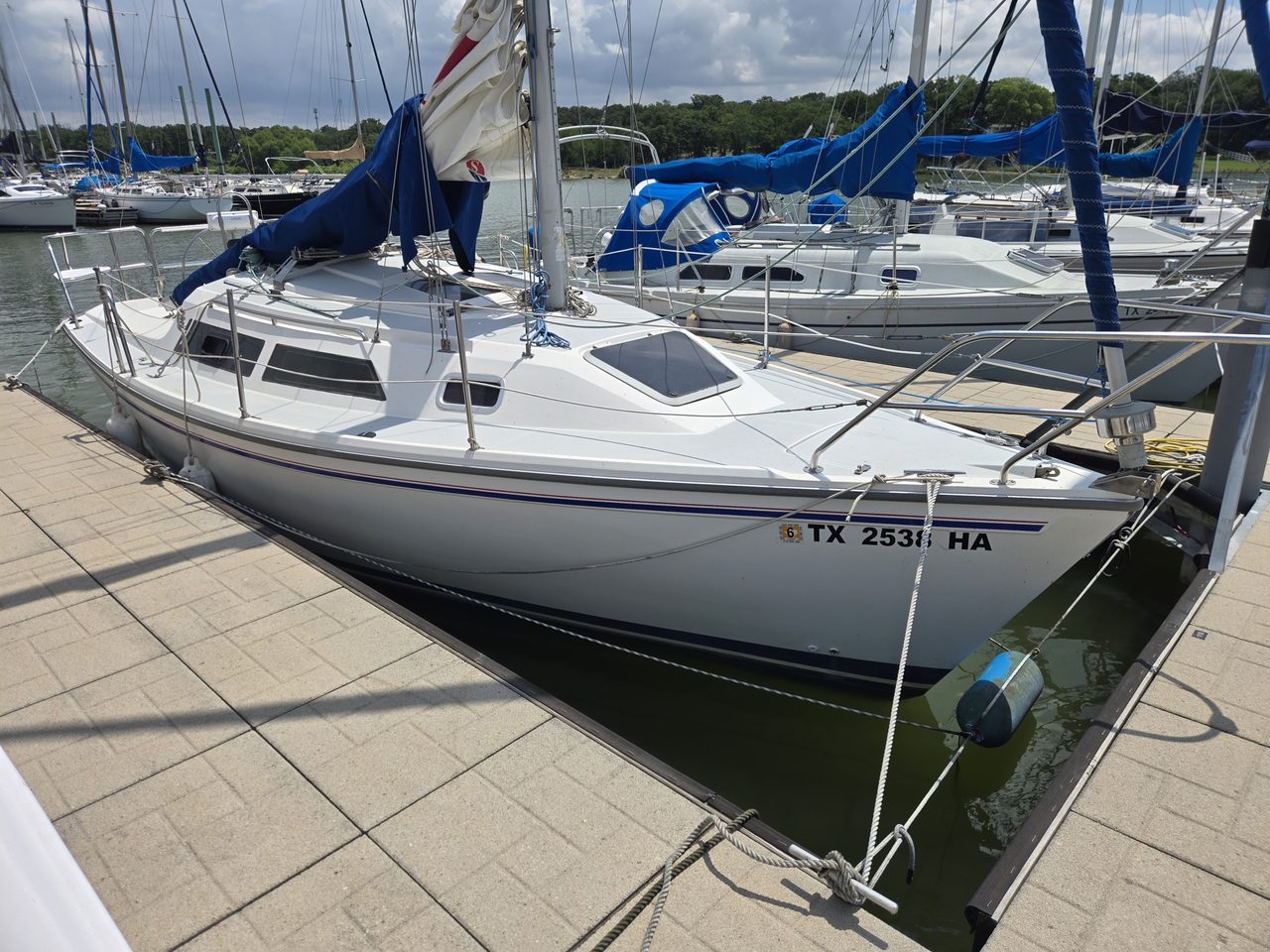
Then we came across a Catalina 270 being sold through Babs Boats. Babs is a broker, a well-known character at DCYC and almost an institution there. She is also a great gal, and she showed us around the boat.
My immediate question was whether I could stand up below. The answer was: mostly. The cabin has about five feet eleven inches of headroom, while I am six foot one. I have to stoop slightly in most places, but there is one spot beside the galley where I can stand upright. Most of the time that you spend in a cabin is spent sitting down anyway, so it felt entirely workable. Martha, at five feet nothing, was untroubled by the question.
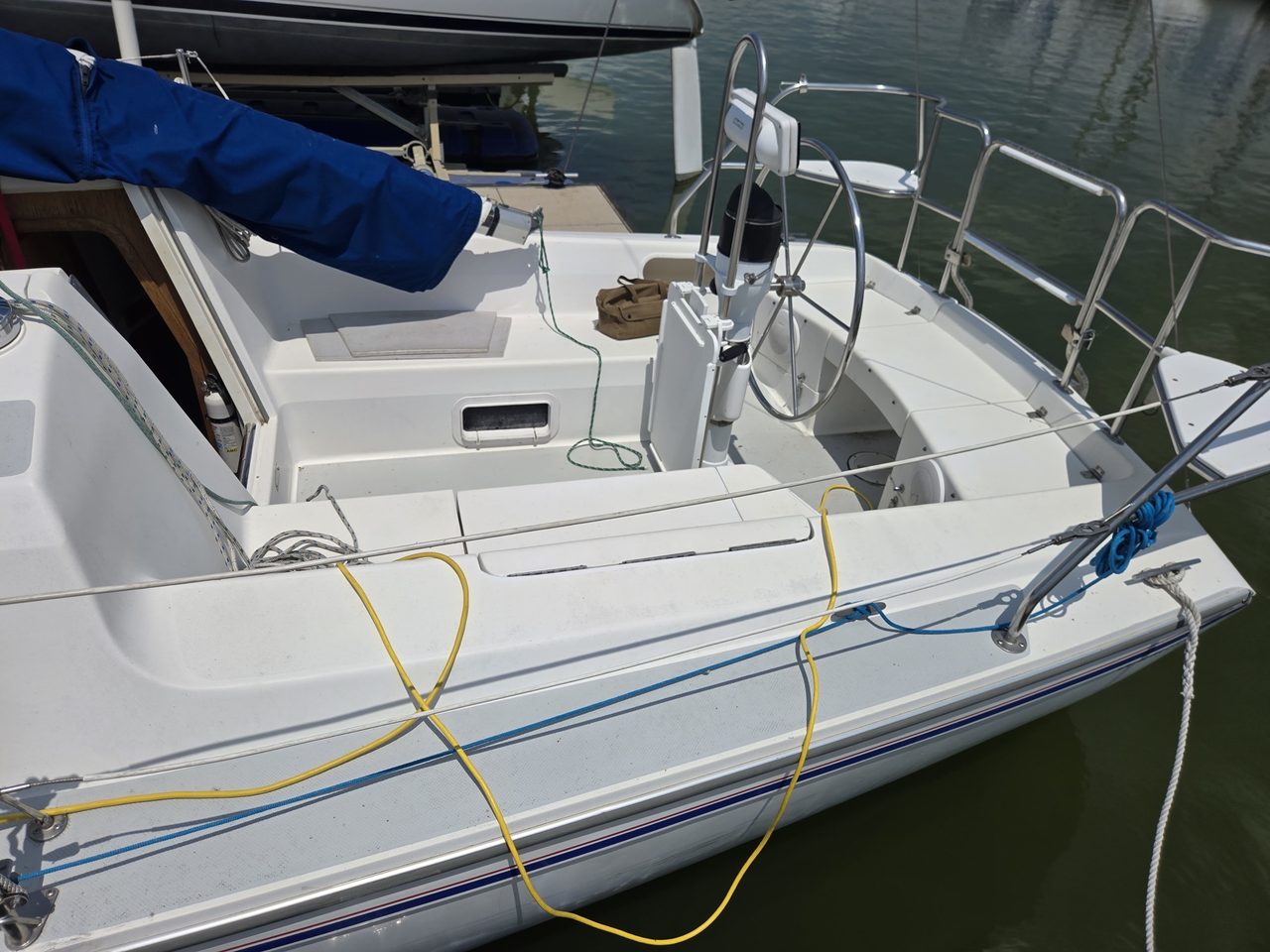
She was a pretty boat. She needed work, but for thirty-three years old she appeared to be in good shape. She was small enough to satisfy Martha, but large enough to have the wheel, diesel, shore power, plumbing and other systems that I wanted to learn. We made an offer and arranged the survey.
Twenty-six pages and one key
The survey had been done four days before the sea trial and had come back about as well as a survey of a thirty-three-year-old boat can. There were things that ought to be done and things that genuinely needed to be done. Both batteries were completely dead, the shore-power inlet had a burnt terminal and water had found its way through several deck fittings. None of it made the surveyor want to run away. When I asked him the only question that mattered, he said that he would buy her himself.
That is not the same as saying that she was perfect. It was better information than that: the problems were the ordinary kind, and the structure beneath them was sound. We decided to proceed and negotiated a little before the handover.
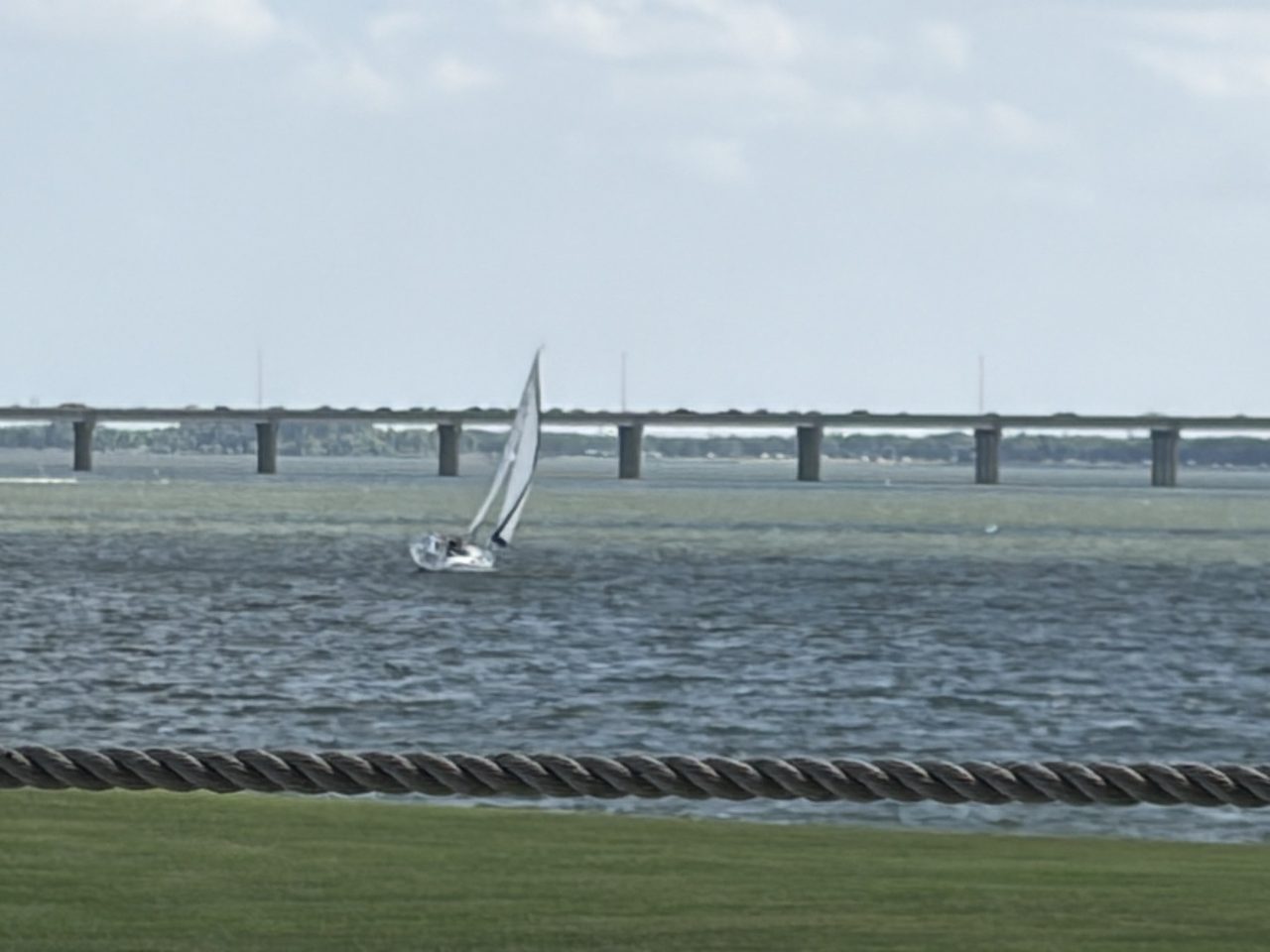
Today was the day. We did the sea trial, I sailed her and loved her, and we wrote the check. Somebody handed me a single key and that was that: we owned a boat.
She came with two brand-new Lewmar 30 winches still in their boxes, bought by the previous owner but never fitted. They will eventually go on the coamings aft, where I can reach them from the wheel. The air conditioning, which had been a sticking point, had been repaired before the handover.
There is a particular feeling to standing on a boat that has just become yours. It is roughly nine parts delight to one part quiet arithmetic about everything on the survey's defect list. Both feelings are correct. The excitement begins.