
A Plan, and a Temporary Solution
The permanent electrical system was becoming a major refit. A cheap battery and a deliberately temporary arrangement gave us something more valuable: time.
A deadline and an engine that would not start
The battery plan is beginning to make sense. The installation is not.
I have selected an AGM battery for the engine and a 105 Ah lithium battery for the house bank. The alternator will remain with the AGM. A new Victron Energy charger will handle the lithium battery from shore power and maintain the starter battery through its smaller secondary output. A dual-circuit switch will keep the two systems separate while giving us an emergency-combine option if the starter battery ever fails.
That is the finished system. Swallow is still sitting in her old slip with two dead batteries, a suspect charger, an unexplained 16-volt survey reading and an engine that will no longer crank.
We have agreed to take a different slip farther inside the marina. It is more sheltered, has a dock box and will be ours for the next twelve months. Once Swallow reaches it, I can dismantle half the boat and take as long as I need to put her back together. Until then, every job has to preserve our ability to move her.
The new Odyssey AGM is available at short notice. The Epoch lithium battery is on back order and looks as though it might be six weeks away. Waiting for every permanent part is no longer a plan. We need to start the engine and move the boat before the new electrical system can possibly exist.
One dangerous number
The surveyor's 16-volt reading makes using the new AGM feel like an expensive experiment. I still do not know what produced it.
The old batteries might simply be so thoroughly ruined that the measurement no longer describes a normal charging system. The Charles shore charger might be defective. The alternator regulator might have failed. Any of those explanations is plausible, and the last two could damage a new battery very quickly.
I could leave the shore charger switched off. That removed one suspect. Moving the boat, however, required the engine, and a running engine meant a running alternator. If the alternator really is producing 16 volts, I will be connecting a brand-new and rather expensive AGM battery directly to the problem that might have killed the old ones.
The correct permanent answer is to test everything methodically. The immediate answer has to survive one short trip across the marina.
The panel becomes part of the problem
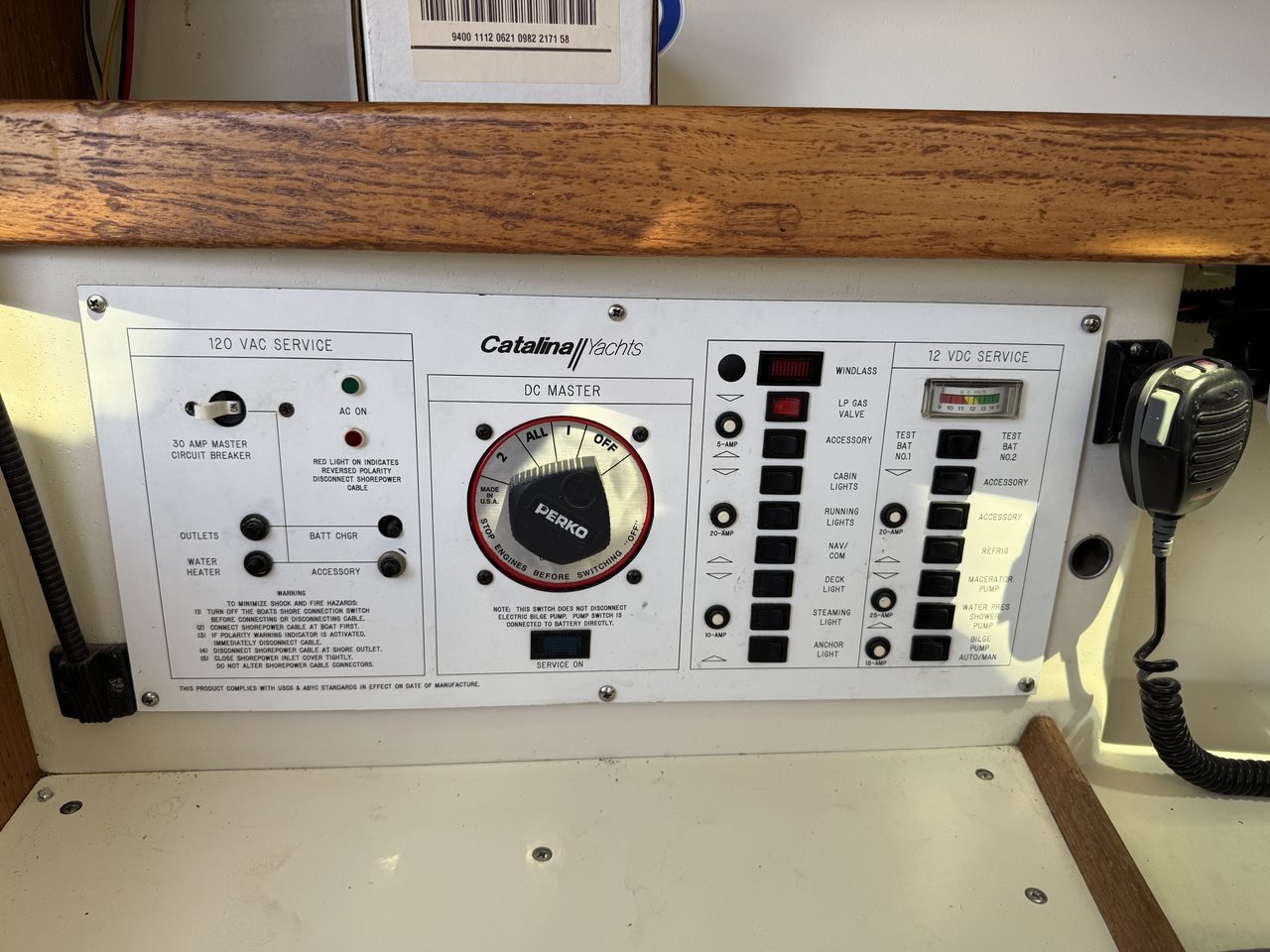
While thinking through the battery layout, I started tracing the existing cables. I had not found all of them yet, but I could begin to see where the original wiring ran and how the replacement system might fit around it.
Every look behind the main panel made me trust it less.
The AC side shows unmistakable signs of heat. Breakers and connections are browned, and parts of the wiring look as though they have been running much hotter than they should. A circuit breaker that has been overheated cannot be trusted to behave at its marked rating. It may trip too readily, take too long or fail to interrupt a fault at all. That is a poor collection of possibilities for the equipment that is supposed to prevent an electrical fire.
The AC breakers are an old push-button style rather than the rocker breakers used on modern marine panels. They are awkward to use as ordinary on-off controls and difficult to test with confidence. The wiring behind them also distributed power through short jumpers from one breaker to the next. Each connection therefore carried not only its own branch load but some or all of the load destined for the breakers farther along the chain.
The DC side has separate switches for lights, pumps and instruments, but not a separate breaker for every switched circuit. Several loads shared one protective device, so one fault could take a collection of unrelated equipment with it.
The built-in battery meter did not add much confidence. Whichever battery I selected, the needle simply flung itself to the end of the scale. It told me neither the battery voltage nor anything useful about its condition. The warning and service indicator lights did not work either. The wiring behind the panel has also seen better days.
Replacing batteries, charger, switch and much of the heavy cabling while retaining that panel is beginning to look like building a new house around an old fuse box.
A panel that solved several problems at once
Catalina Direct supplies an extraordinary range of replacement parts for older Catalinas, including a modern electrical panel designed for this installation. Its overall layout is familiar and it fits the space occupied by the old panel, but the details address nearly everything that is beginning to worry me.
The shore-power section is enclosed so that opening the front of the panel does not expose live AC terminals. Proper bus bars distribute the supply instead of a daisy chain of small jumper wires. Modern rocker breakers can serve as both switches and overcurrent protection. On the DC side, each switched circuit has its own breaker rather than sharing protection with several neighbors.
It is not cheap. It is also becoming difficult to justify spending this much time and money rebuilding everything around it while leaving the least trustworthy part of the system in the middle.
A battery bought to be temporary
I do not enjoy spending money on temporary solutions. I particularly dislike spending serious money on something that I already know I intend to replace.
This did not need to be serious money.
I bought the cheapest flooded marine starting battery at Walmart that was large enough to crank the Perkins. It did not need sophisticated chemistry, deep-cycle performance or a ten-year future aboard Swallow. It needed to start the engine and tolerate whatever we discovered about the alternator during a journey of a few hundred yards.
The new Odyssey AGM can sit in the other battery position as the temporary house bank. I will keep it isolated from both suspect charging sources: no Charles shore charger and no alternator connection. It can run the modest DC loads that we need without being put at risk while we learn what the rest of the system is doing.
The selector will be placed on the inexpensive flooded battery for the engine start and the move. If the alternator voltage proves healthy, excellent. If it is genuinely overcharging, the battery exposed to it will be the disposable one rather than the AGM that is intended to become our permanent starting battery.
This is not the architecture that I want to keep. It is a controlled bridge from an unmovable boat to a permanent slip.
Buying back the time
The temporary arrangement changes the problem immediately, even before the engine turns.
We no longer have to wait six weeks for the lithium battery. We do not have to install the new charger, solve the permanent cable routing or commit to the new panel before moving the boat. We do not have to expose the Odyssey to a charger or alternator that we have not yet cleared. One inexpensive battery buys us a safe test and, if that test passes, the short move that removes the deadline.
The permanent layout can then develop at the pace it requires. The lithium house bank, AGM starting bank, Victron charger, battery monitor, dual-circuit switch, Class T fuse, MRBF and new distribution panel all need somewhere to live. Their cables will follow different paths from the original ones. Several existing conductors are too small for the loads or protection in the new design, and others are old enough that replacing them will remove a question that I do not want to carry forward.
That means crawling into lockers, tracing cables behind cabinets and pulling heavier new wire through spaces that were not designed for easy access. It will not be a small job. It will, however, leave us with cables sized for their loads, fuses sized for their cables, and a layout that somebody could follow without having to reverse-engineer three decades of additions.
For the first time, the expanding scope does not increase the stress. The temporary system has separated the urgent job from the important one. Get Swallow to her permanent slip. Then take the electrical system apart once, rebuild it properly and put the boat back together when it is ready.
I suppose this is what boat ownership really is. You begin by buying two batteries. A few days later you are designing an electrical system, replacing a panel and buying a third battery whose principal virtue is that you do not mind sacrificing it.
At least now we have a plan.