
A Tale of Two Batteries
Two dead batteries should have meant buying two new ones. Instead, they led to a new charging system, a safer way to divide the boat's power and the beginning of a much larger electrical refit.
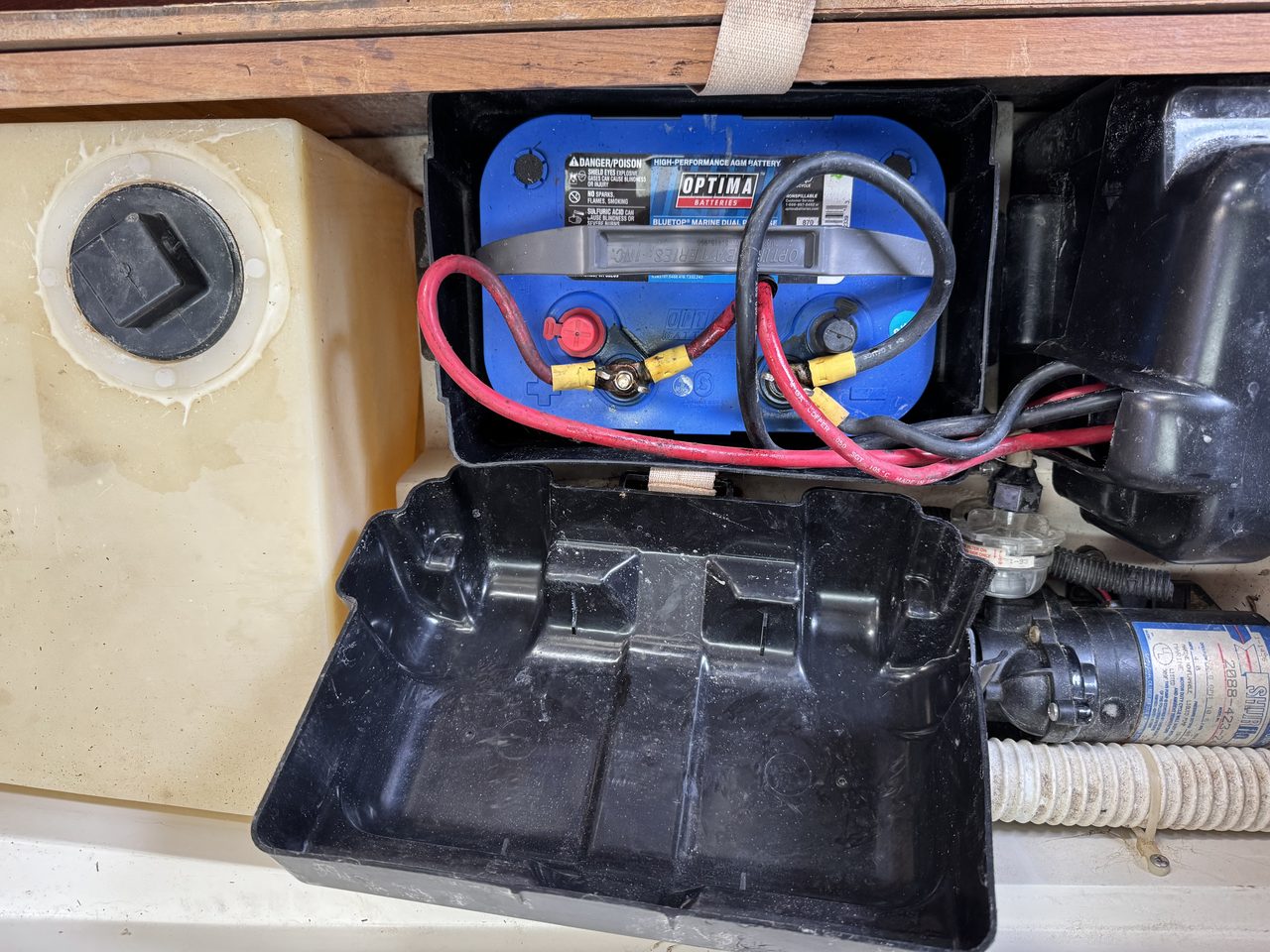
Two very good dead batteries
We knew before buying Swallow that both of her batteries were dead. They were not cheap batteries, either. They were Optima BlueTop D34Ms: spiral-wound AGM batteries that were among the better marine batteries available when somebody deliberately upgraded the boat with them. New ones cost roughly $400 each. Replacing the pair therefore put about $800 into the budget before we had done anything interesting at all.
That was not a surprise. The survey had found one battery visibly swollen, both were well past a reasonable service life, and we had negotiated a small reduction in the price to allow for them and a few other minor matters. The question was not whether we needed to spend money. It was what we should buy once we started spending it.
It is easy to think that a battery is simply a battery. I certainly understood that some were better than others, but the differences turned out to reach much farther into the boat than I had appreciated.
A short detour into battery chemistry
The traditional flooded lead-acid battery is simple in principle: lead plates sit in liquid electrolyte, and the chemistry between them stores and releases electrical energy. It remains an excellent way to start an engine. A starter needs an enormous amount of current for a few seconds, after which the alternator immediately begins replacing what was used.
What a starter battery does not particularly enjoy is being drawn down slowly and deeply, then charged again, day after day. That repeated discharge and recharge is a cycle, and every battery chemistry has a finite cycle life.
Battery capacity is normally expressed in amp-hours. In very broad terms, a 100 Ah battery could supply one amp for 100 hours, five amps for 20 hours, or some other equivalent combination. The real result depends on the discharge rate, temperature, age and several other details, so the number is a rating rather than a promise.
Depth of discharge matters as well. A lead-acid battery can physically be discharged much farther than the conservative limits commonly used in boat design, but repeatedly doing so shortens its life. That is why people often plan around using only about half of an AGM house bank before recharging it. The unused half has not disappeared; leaving it there is how you buy more cycles from the battery.
AGM stands for absorbent glass mat. It uses the same basic lead-acid chemistry, but the electrolyte is held in fiberglass matting rather than sloshing freely around the case. That makes the battery sealed, spill-resistant and much better suited to a boat that heels, bounces and lives in a damp environment. AGMs also have low internal resistance, accept charge well and can deliver the heavy current needed to start an engine. The Optimas on Swallow were about 55 Ah each, not 100 Ah, but they were strong dual-purpose batteries for their size.
Lithium iron phosphate, usually written LiFePO4, changes the calculation. It is one of the more thermally stable lithium chemistries and has become common on boats and in RVs. A LiFePO4 battery is far lighter than an equivalent lead-acid bank, can routinely use nearly all of its rated capacity, holds its voltage well under load and can deliver thousands of cycles when treated properly.
The replacement house battery I have in mind is rated at 105 Ah and weighs about 22 pounds. One old Optima weighed roughly twice that while offering only 55 Ah on its label and substantially less capacity that I would want to use routinely. Lithium would not merely replace the old house battery. It would give us much more usable power and should last for many years.
More battery than the boat needs
Swallow does not need lithium. She has no refrigerator, no television and no battery- powered air conditioning. Her air conditioner runs only from shore power. The electronic instruments are modern but modest, and a Catalina 270 on a lake does not need an enormous house bank to keep its lights and radio working for an afternoon.
The future list is a little different. I would like to convert the icebox into a proper DC refrigerator. An autopilot would make an excellent extra crew member when I take the boat out alone. Monitoring equipment, communications and the collection of small loads that accumulate on a modern boat all need somewhere to get their power.
There was another reason. Swallow is partly a rehearsal for a larger boat. Lithium would be a serious candidate, perhaps the obvious candidate, on that boat. Learning how to design, install and live with it here has value of its own.
I do not want to spend serious money on a halfway house. A proper AGM starting battery and a LiFePO4 house battery seem to give each job the chemistry best suited to it. That decision, unfortunately, is where the simple battery replacement stops being simple.
The alternator problem
Lead-acid batteries and automotive-style alternators have grown up together. After an engine starts, a depleted lead-acid battery initially accepts a healthy charging current. As its state of charge rises, the current it will accept falls away. The alternator may work hard at first, but the battery naturally eases the load before long.
Lithium does not behave that way. A depleted LiFePO4 battery can accept a large charging current and continue accepting it for much longer. Connect one directly to an alternator designed around lead-acid behavior and the battery may ask for everything the alternator can produce until it is nearly full.
That is particularly unkind on a sailboat. The alternator is derived from an automotive design, but it lives in an enclosed engine compartment with none of the cooling airflow that a moving car enjoys. Its own fan turns slowly when the diesel is idling or puttering out of a marina, which is exactly when a depleted battery may be demanding maximum output. An alternator forced to run flat out for too long can overheat, damage its windings or diodes and, in the worst case, become a fire risk.
The house battery therefore could not simply replace one Optima while everything else remained unchanged.
Two batteries become two systems
Swallow has the familiar 1 - BOTH - 2 - OFF battery selector found on boats of her era. That arrangement dates from a sensible idea. One battery can run the boat while the other is held in reserve, ensuring that lights, instruments and radios do not consume the last energy needed to start the engine. With the engine running, selecting BOTH connects the alternator to both batteries so that they can recharge.
It works, but it relies on the operator remembering which battery is doing what. It also creates a dangerous opportunity. If the switch passes through OFF while the engine is running, the alternator can suddenly lose the battery that was absorbing its output. The alternator does not stop generating instantly. The resulting load-dump voltage spike can destroy the alternator's diodes and damage expensive electronics elsewhere on the boat.
My answer is a Blue Sea 5511e dual-circuit switch. In normal use it switches two independent circuits at the same time. One side connects the AGM starting battery to the engine and alternator. The other connects the lithium house battery to the boat's domestic loads. Turning the switch on energizes both systems, but does not join the batteries together.
That gives each battery one clear job. The starter battery can deliver a large burst of current, crank the engine and be replenished by the alternator. The house battery can be drawn down by the boat's systems without touching the reserve needed to start the engine. The alternator remains on the lead-acid side and never directly sees the lithium battery.
The switch also has an emergency COMBINE position. If the starter battery ever fails, the house battery can briefly be connected to help crank the engine. That is an emergency procedure, not a normal charging arrangement: combine for the start, then separate the banks again once the engine is running.
In the new design, the alternator doesn't charge the lithium battery, ever, so its output can now land on an unswitched part of the starting circuit — messing with the battery switch cannot disconnect it from the AGM battery, so the load-dump trap disappears right along with the old selector.
How does the house battery recharge?
The usual answer is a DC-to-DC charger. The alternator maintains the starter battery, and the DC-to-DC charger takes a controlled amount of that energy and converts it into the charging profile required by the lithium house bank. The alternator therefore contributes to the house battery without being exposed to its appetite directly.
I decided that Swallow did not need one, at least not yet. She is a lake boat. We will normally sail for part of a day and return to a slip with shore power. A 105 Ah house bank is unlikely to be seriously depleted during that time, and the shore charger can restore whatever we use once we come home.
If Swallow ever begins making longer trips, adding a DC-to-DC charger later is straightforward. Solar would be another answer. A future bimini could carry panels that charge the house bank independently of the engine. Both are useful options, but neither is necessary to make the first version safe and complete.
One new battery becomes a new charger
The existing charger is a Charles Industries 20-amp ferroresonant unit. It is a solid design for the lead-acid batteries it was built to serve, but it cannot provide the charging profile required by LiFePO4. The battery decision therefore became a charger decision as well.
I chose a Victron Energy Phoenix Smart IP43 12/30. Its main output can supply up to 30 amps to the house bank. A second output can maintain the starter battery with up to four amps, subject to the charger's total 30-amp limit. At the dock it can support the boat's ordinary DC loads while charging whatever the house battery used on the water, and it can keep the AGM starter battery healthy at the same time.
Victron will also give us something that Swallow has never had: information. The charger, battery monitor and other Victron components can report what is flowing into and out of the bank, its state of charge and the system's history. That information can appear on a display aboard, on a phone nearby or, with the small LTE modem that I plan to add, from almost anywhere. Eventually I hope to make some of it available remotely as well.
The charger replacement also appeared to dispose of one of the survey's more alarming findings. The surveyor had measured about 16 volts at the battery terminals. A healthy 12-volt AGM system normally rests in the high 12s when full and will commonly see charging voltage around the mid-14s during absorption, falling to roughly 13.5 to 13.8 volts on float. Sixteen volts was not a normal charging value.
I do not yet know the cause. The reading might have been a strange result from two ruined batteries. The Charles charger might have lost control of its output. The alternator regulator might have failed, which would add an alternator repair to the list. Replacing the batteries and shore charger would remove the first two variables. Testing the alternator afterward would settle the third.
The battery problem is becoming a charging-system problem, and it still has one more layer to add.
A fuse has one job and two important numbers
The original installation reflected the standards and habits of 1993. Large battery cables could run a considerable distance before encountering meaningful overcurrent protection. That is not how I wanted to rebuild it.
A fuse is commonly described as protecting the appliance at the far end of a cable. Its more important job is to protect the cable itself. If a conductor sized for 30 amps is allowed to carry hundreds, the insulation can melt and the wire can start a fire long before the connected device fails politely. The fuse must open before the conductor exceeds what its gauge, insulation and installation can safely carry.
That gives the fuse its familiar current rating. The less familiar number is its ampere interrupting capacity, or AIC: the largest fault current that the fuse can safely stop. A battery short circuit can release astonishing current. If that exceeds the fuse's interrupt rating, the element may vaporize while the electrical arc continues through the space it occupied. The fuse has opened mechanically but failed electrically.
Lithium makes that distinction especially important because of its low internal resistance and very high possible fault current. The house bank will therefore use a Class T fuse, whose high interrupt capacity is suited to a lithium battery. The AGM starting battery will use a compact marine-rated battery fuse, or MRBF, mounted directly at its terminal. Each smaller branch will receive protection matched to the wire that leaves the main distribution point.
The Class T is large, needs its own holder and is distinctly not cheap. The MRBF is smaller, simpler and less expensive. Neither is exciting in the way that a new instrument or autopilot is exciting. Both are the sort of equipment that lets me put Martha, Izzy, family and friends aboard without wondering whether an invisible fault behind a cabinet is turning a battery cable into a heating element.
The small job disappears
We began with two dead batteries and an $800 allowance to replace them. The sensible answer has become an AGM starting battery, a lithium house battery, a new dual-circuit switch, a lithium-capable charger, proper battery monitoring, a Class T fuse, an MRBF and new protection wherever the conductor size stepped down.
None of those additions is there for novelty. Each answers a real consequence of the choice before it. Lithium offers much more usable energy, but demands a deliberate charging design. Separating the banks protects both the alternator and our ability to start the engine. Replacing the charger makes the chemistry work at the dock. Correct fusing makes the finished system safe rather than merely functional.
The question is no longer which two batteries to buy. It is where all of this equipment will fit, how the cables will reach it, what order the work has to happen in, and whether it still makes sense to attach a completely new electrical system to a 33-year-old distribution panel.
That is the next problem.