
Hello? Is anyone out there?
The survey told me what was wrong. Three Catalina 270 owners helped me understand what a 270 should look like, and a voice from the dock started the clock on moving Swallow.
The things that fit in a shopping bag
The survey gave me twenty-six pages of things to think about. Some of them required very little thought at all. The fire extinguisher had expired. There was no carbon-monoxide detector, no smoke detector and no horn. These were not boat projects so much as shopping items. I bought what I could find, carried it aboard and began working down the list.
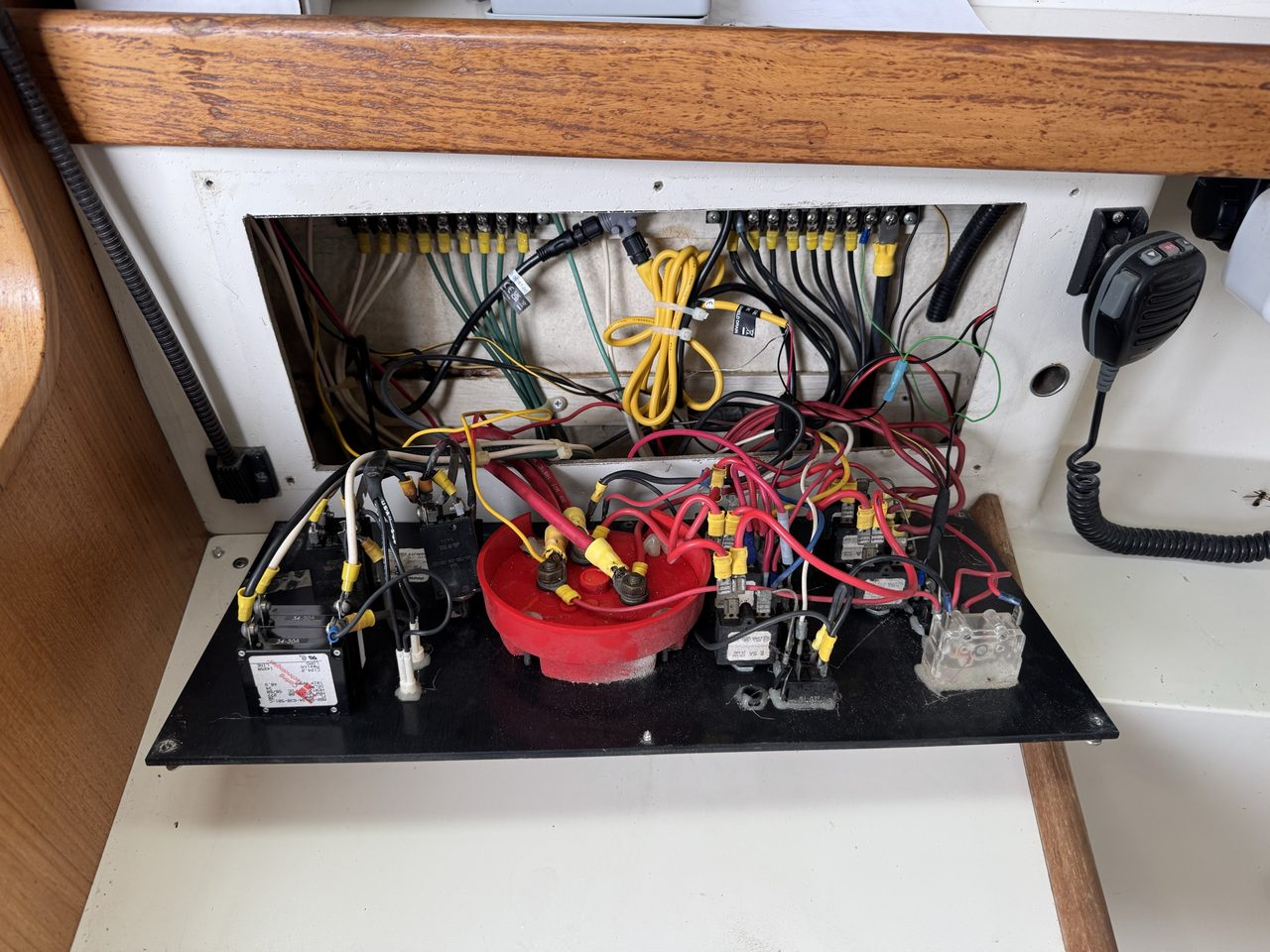
The batteries were different. Both were old, one was visibly swollen, and the surveyor had measured 16 volts at the terminals. That was far too high for a 12-volt system. It might have meant that the batteries were being badly overcharged, or it might have meant that the reading was wrong, but either answer needed investigating.
Had Swallow come with two recent, healthy AGM batteries, I doubt that I would have started down this particular path. She did not. I knew that both batteries had to be replaced, and I was not going to replace them with the cheapest things that would fit. That turned a simple purchase into a chain of questions about the charger, the alternator, the wiring and what the electrical system ought eventually to become.
The battery story deserves an entry of its own. At this point, the important fact was that I did not know even what I did not know.
What was I looking at?
I could recognize things that did not look right. I could not yet tell where the cables ran after they disappeared behind a panel, which parts were original, which had been added later or what a normal Catalina 270 installation ought to look like.
That last question was harder than I expected. I had thought about a great many boats over the years, but I did not know that the Catalina 270 existed until one appeared in our rather short search. There is plenty of information about the original Catalina 27, one of the most successful sailboats ever built. The 270 was its second generation, not the same boat with a new number. The hull, interior and many of the systems had changed, so an answer that was right for a Catalina 27 was not necessarily right for Swallow.
I went looking for owners who had already taken their 270s apart and, more usefully, had put them back together again.
People who had already found the answers
Marc Robic's SV Aquaholic 3 channel was the first real find. Marc and his wife, Claude, sail a 1995 Catalina 270 from Montreal. Their boat is only two years newer than Swallow and has the same Perkins Perama M20 engine. Marc's videos showed the systems in a boat that was close enough to mine that I could use it as a point of reference. He also writes about boat maintenance from time to time, and his material is practical, specific and based on work that he has actually done aboard.
Jyri J. Virkki's Catalina 270 pages document a 2000 boat, hull 285, with a Westerbeke 20B Two. The later engine and some other details differ, but much of the boat is familiar. His notes on the running rigging and lazyjacks gave me ideas for work that will come later. One page had a more immediate effect. Jyri had found severe overheating hidden behind his shore-power inlet and replaced the old twist-lock connector with a SmartPlug. With a burnt inlet already on Swallow, that solution lodged in my mind.
David Branby's Splendido was closer still: another 1993 Catalina 270, kept on Lake Tahoe and documented across years of maintenance and improvement. David's articles gave me a trail through mechanical jobs, seasonal work and the small discoveries that accumulate when somebody has cared for the same boat for a long time.
None of these people knew me. Between them, they had left enough photographs, videos and notes that I could begin to distinguish Catalina's choices from a previous owner's changes, and an oddity from something that was simply unfamiliar to me. There will be many other useful fragments, but Marc, Jyri and David have given me the first three working examples of what a Catalina 270 can be.
They are also part of the reason that I want to leave a record of my own. Their work is already saving me time, giving me ideas and warning me away from mistakes. Perhaps another Catalina 270 owner will one day find my account and learn something from the problems that I solve, or even from the problems that I create for myself along the way. Writing it down will be my attempt to pay forward some of what Marc, Jyri and David have given me.
A voice from outside
I was aboard Swallow with the air conditioning running while I tried to make sense of the batteries and the voltage readings. The air conditioning was not helping very much, although I did not yet understand why. Its raw-water pump was certainly working: a steady stream was pouring from the discharge through-hull into the lake.
Then a voice arrived from outside.
That was how I met Laurie.
She was on the board at Dallas Corinthian Yacht Club. I had submitted my membership application by then, but the board had not yet met to consider it, so technically I was not a member. Swallow was still in the slip that she had occupied before the sale, which I assumed was paid through the end of the month by the previous owner.
Laurie had heard water gushing from the boat and thought that it might be the bilge pump. An unattended boat pumping that much water deserved investigation, in case somebody needed to find the owner quickly. She was relieved to discover that the owner was already aboard and that the water came from the air-conditioning circuit, not the bilge.
I explained that I had just bought the boat and was trying to work out what needed to be done first on a list that seemed rather daunting. Laurie asked whether I was happy in the slip. She had another one available farther inside the marina and was looking for somebody to lease it.
The original slip was perfectly serviceable. Laurie's was a little more protected from rough weather and came with a dock box. The box mattered more than I might have guessed before owning a boat. It would give the tools, cleaning supplies and parts somewhere to live other than in the cabin.
A clock starts running
I spoke to Martha when I got home. We agreed that the calmer position and the dock box made the new slip the better choice. I messaged Laurie, and we arranged that I would take it from the first of the month.
That gave the work a deadline. Before I dismantled anything substantial, Swallow had to be able to leave her old slip and reach the new one under her own power.
Earlier, before leaving the boat, I turned the key.
Nothing happened.
The engine had started during the sea trial. I had started it myself since then. This time it would not crank, and I did not know why. With two old batteries already condemned by the survey, they were the obvious place to begin.
That is the story of two batteries.