
Continuing investigations
Shore power lets me test the systems that depend on it. The answers condemn two old panels, expose an air conditioner that is not conditioning anything, and begin the search for an engine fault.
Getting 120 volts back aboard Swallow was supposed to make the rest of the refit easier. The battery charger could maintain the batteries, the automatic pumps could remain powered, and, most urgently in August in Texas, the air conditioning could make the cabin somewhere that a person might work for longer than an hour at a time.
The shore-power repair has done the first two. The air conditioning has chosen a different path.
The hot wire behind the panel
The old AC/DC distribution panel has worried me since I first opened it. Several of its push-button breakers are browned from heat, the wiring behind it has seen better days, and the panel is old enough that I cannot assume that any breaker which has been overheated will still open when it should.
Running the air conditioner makes the problem much less theoretical. With the compressor on and the boat drawing about 19 amps, the wiring at the panel becomes very hot and the smell of heated insulation reaches the cabin.
The heat is not coming from an air-conditioning breaker carrying too much current. The old panel distributes its incoming live supply by daisy-chaining one breaker to the next with short jumper wires. A jumper near the beginning of that chain therefore carries the combined load of everything downstream from it. The battery-charger breaker is browned because it happens to sit beside one of those heavily loaded connections, not because the charger is causing the problem.
That distinction matters. Remaking one terminal would not cure the design. The replacement Catalina Direct panel that is already waiting to go in uses a proper bus bar across the breakers, sized to carry the panel's full load. That removes the overloaded jumper rather than repairing it and leaving the same arrangement in place.
I will not run the air conditioner again through the old panel. The replacement panel was already part of the electrical refit; it is now the first substantial job in it.
An air conditioner with no air
The air-conditioning installation has a second problem that has nothing to do with its electrical supply. The unit sits under the forward berth in a closed compartment, but there is no proper return-air opening into that compartment. It has been trying to breathe through the finger hole in the removable wooden cover and whatever small gaps exist under the berth cushion.
That is not enough air for a 16,000 BTU unit. It also means that the thermostat can end up sampling a small pocket of air that the machine has already cooled rather than the cabin that it is supposed to be cooling. The compressor can stop because that pocket has reached the set temperature while the rest of the boat remains hot.
I removed the cushion and the wooden cover, leaving the whole compartment open to the cabin, and ran another test. The current dropped from the 18.5 to 19 amps that I had seen with the compartment closed to about 15 amps with it open. That does not isolate the reason for the difference: opening the compartment changes both the air entering the evaporator and the heat around the machinery. It does confirm that any replacement needs a real return-air grille and enough ventilation around the unit.
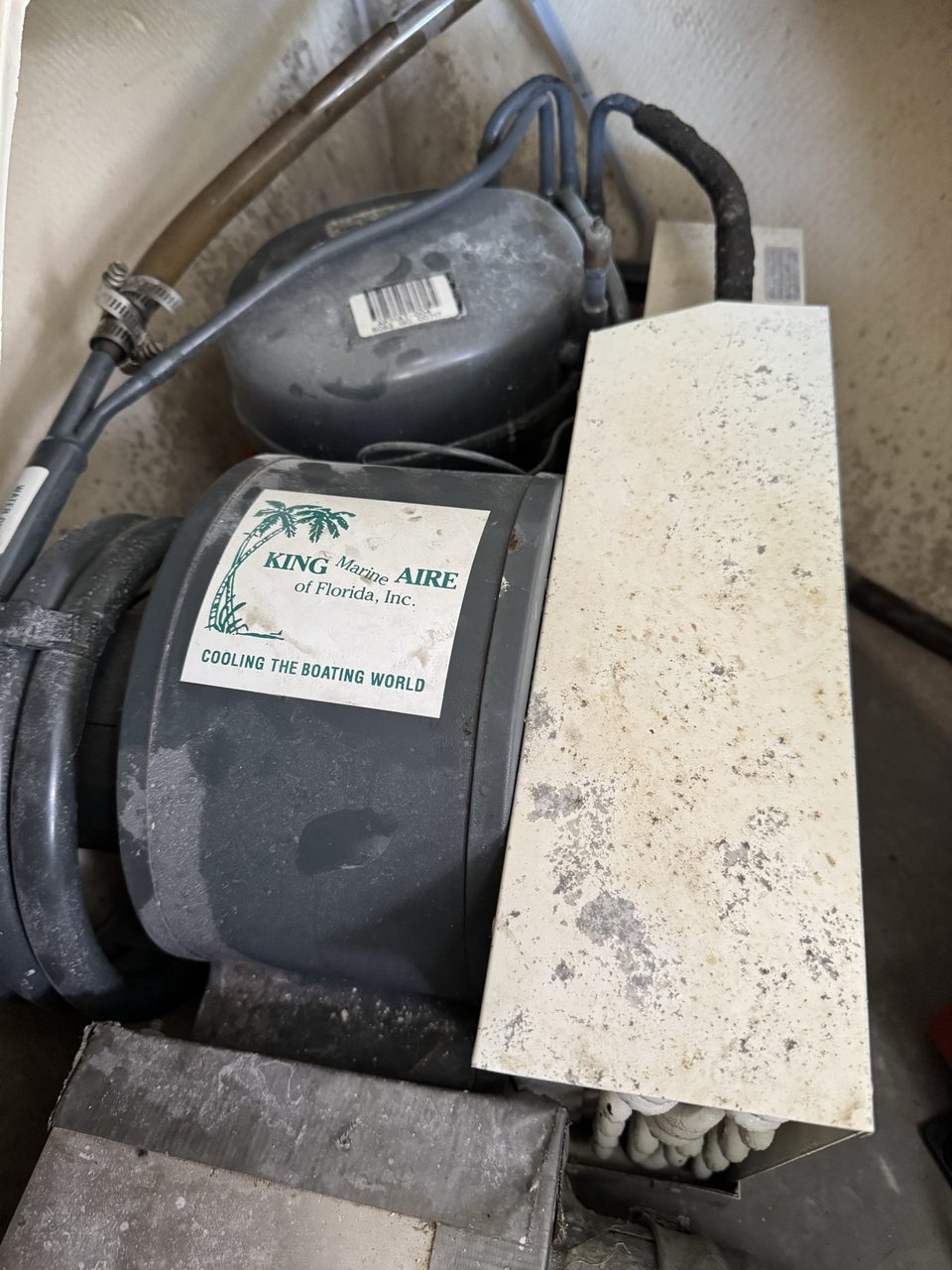
Unfortunately, airflow is not the whole problem.
The wrong kind of noise
With the compartment open, the blower moves plenty of air. None of it is meaningfully cold. There is no condensate, nothing on the unit becomes cold, and I cannot distinguish the refrigerant lines from one another by touch. A working system should make that difference obvious: one side should be cold, while the other carries away the heat that has been removed from the cabin.
The clamp meter supplies another clue. As the compressor stops, the display briefly jumps to OL, indicating a current beyond the meter's range. More decisively, the reading is preceded by large mechanical thunks from inside the unit. An electrical measuring artifact does not make a noise.
Whether the compressor is stalling, trying to compress liquid refrigerant or moving on failed internal mounts is not especially important now. The unit is more than thirty years old, it is not moving heat, and the compressor is making mechanical noises that a compressor should not make. It is finished.
That is disappointing, although it does simplify the decision. A 16,000 BTU fixed-speed unit was always much too large for a 27-foot boat, and its 15-to-19-amp appetite is a poor fit for our 20-amp dock supply even if it could still cool. I measured the compartment while it was open. The 9,000 BTU variable-speed Mabru unit that we have selected will fit with room to spare, draw a fraction of the current and modulate rather than repeatedly starting and stopping at full output.
The old unit can come out. Before it does, I need to trace one duct that disappears aft from its supply plenum while the blower can still push air through it. If it already feeds the rear berth, that is useful plumbing that I would rather discover now than recreate later.
A tachometer that tells the wrong story
The engine investigation begins with another instrument that I can no longer trust.
The tachometer in the cockpit panel has always read implausibly low. Listening to an engine is not a measurement, so I brought an optical tachometer aboard and put reflective tape on the pulley. The optical reading confirms that the panel tachometer is not merely a little out of calibration. Its indication bears very little relationship to the engine's actual speed.
At a measured idle of about 800 rpm, which is appropriate for the Perkins, the engine shakes violently. It smooths out somewhere above 1,200 rpm. I had originally found the idle adjusted high enough to conceal much of that roughness and turned it back down to the proper setting. The result is not an idle adjustment problem. It is an engine problem that the high setting had been masking.
The roughness is the same in neutral and in gear. That is useful because it points away from the damaged propeller, shaft and alignment. Whatever is happening is on the engine side: fuel delivery, an injector, compression or something else that has yet to be isolated.
The rest of the cockpit panel offers little reassurance. The low-oil-pressure and high-temperature warning lights do not work, and there is no audible alarm. Even if the gauges were accurate, the panel sits down by my feet where a silent warning light is easy to miss while underway.
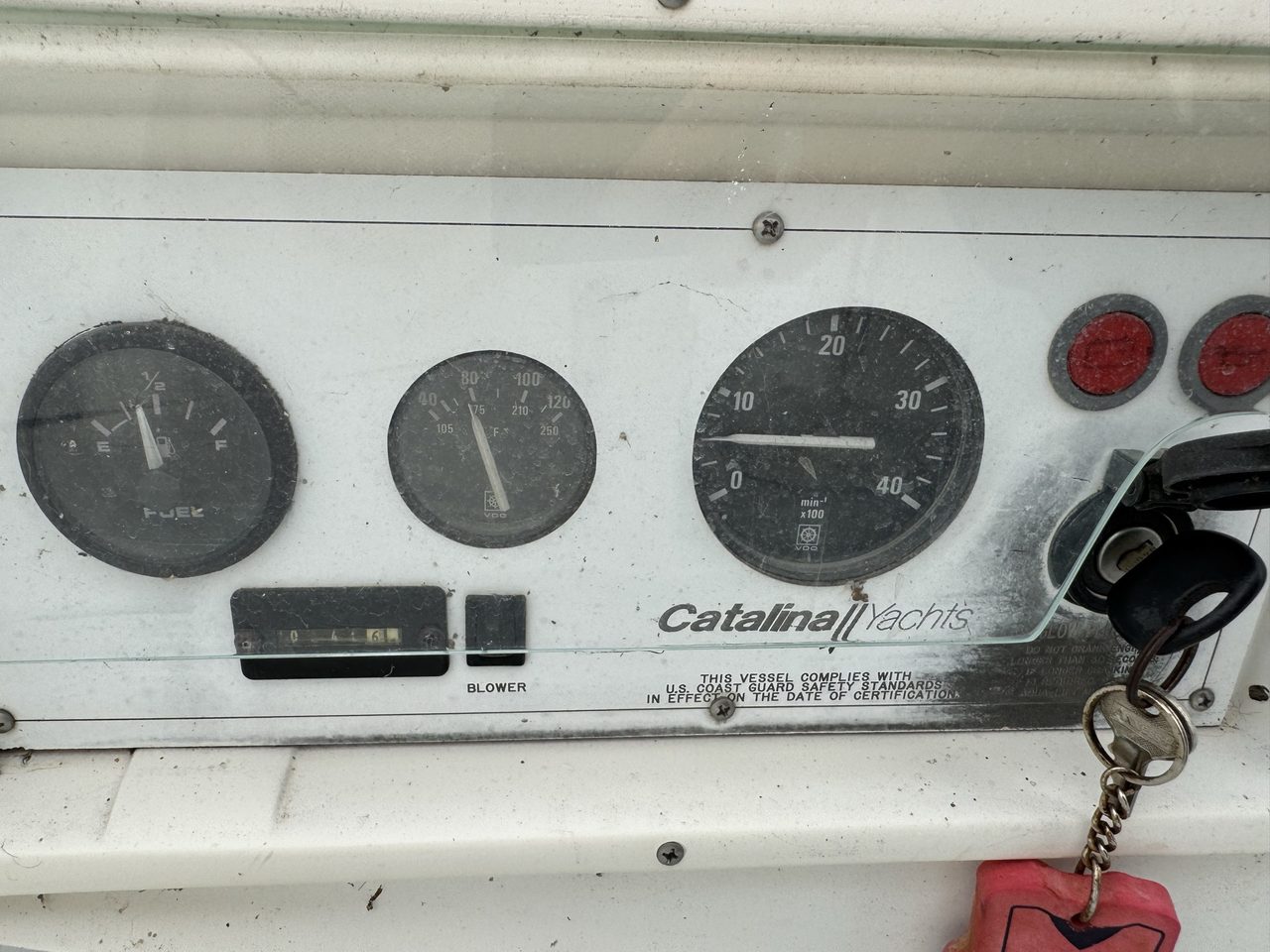
The replacement engine panel will provide a trustworthy tachometer, working warning lights and an audible alarm. It is another job, but not the next one. The main distribution panel is carrying shore power through a connection that is already overheating; that panel comes first. Once it is replaced and the cabin electrical work is under control, I can return to the cockpit panel and the engine fault behind it.
Fewer mysteries, more work
Nothing has been repaired today. The main panel is still old, the air conditioner is still dead and the engine still shakes at idle. What has changed is the order of work.
The main electrical panel comes first because it has demonstrated that it cannot carry the air-conditioning load safely. The old air conditioner can then come out, leaving room to build the return-air and ducting arrangement properly before its replacement arrives. The engine panel follows once the main electrical work is complete, and the engine investigation can proceed with an instrument that tells the truth.
The list has not become shorter. It has become less mysterious, which is probably the most that one should expect from a day devoted to continuing investigations.